International sanctions are a cornerstone of modern statecraft, often deployed as the primary weapon of financial warfare. When nations are designated as state sponsors of terrorism, engage in human rights abuses, or launch unprovoked wars, the global community responds by cutting off their access to the international financial architecture. The desired result is isolation, economic collapse, and a modification of behaviour of Shadow Economy.
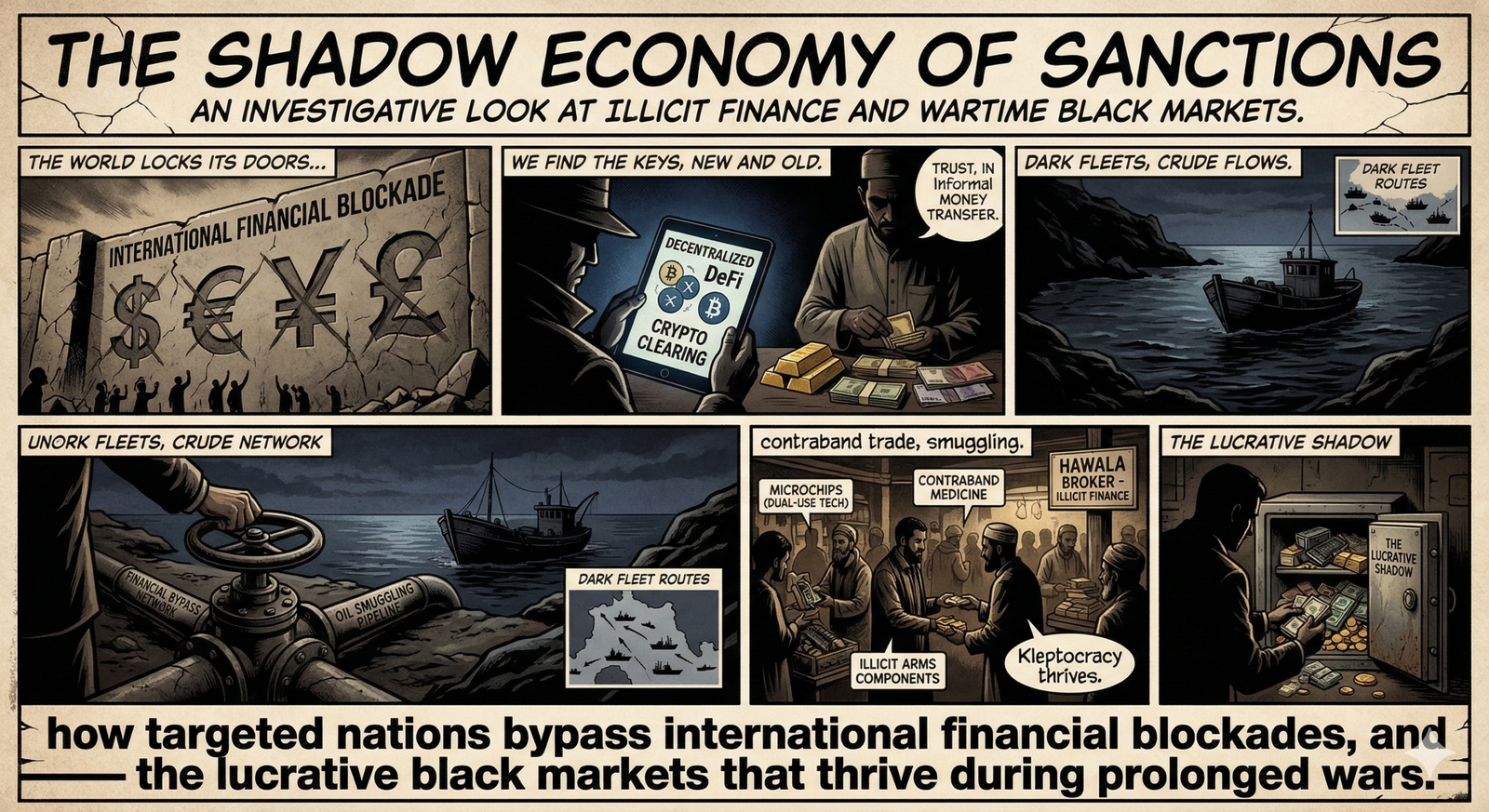
However, historical and contemporary evidence demonstrates a stark reality: sanctions are never 100% effective. While they undoubtedly inflict severe economic pain, they also act as a catalyst for a robust, adaptive, and extremely lucrative parallel system. This phenomenon is known as the shadow economy of sanctions, an investigative look at how targeted nations bypass international financial blockades and the black markets that thrive during prolonged wars. Rather than achieving absolute isolation, sanctions often force targeted states to master the art of illicit finance, creating new networks that persist long after the conflict ends.
The Financial Warfare Landscape: How Sanctions Cut Off Nations
To understand the shadow economy, one must first grasp the severity of the financial blockade. The modern global economy is hyper-connected, reliant on an intricate web of correspondent banking relationships, currency clearing centers, and digital messaging systems, most notably SWIFT (Society for Worldwide Interbank Financial Telecommunication).
When comprehensive sanctions are applied, the primary goal is financial strangulation. Targeted nations are evicted from SWIFT, disabling their ability to execute cross-border transactions efficiently. The U.S. dollar, as the global reserve currency, becomes a potent weapon, as almost all dollar-denominated trades must pass through U.S. financial institutions, allowing Washington to freeze assets and block payments.
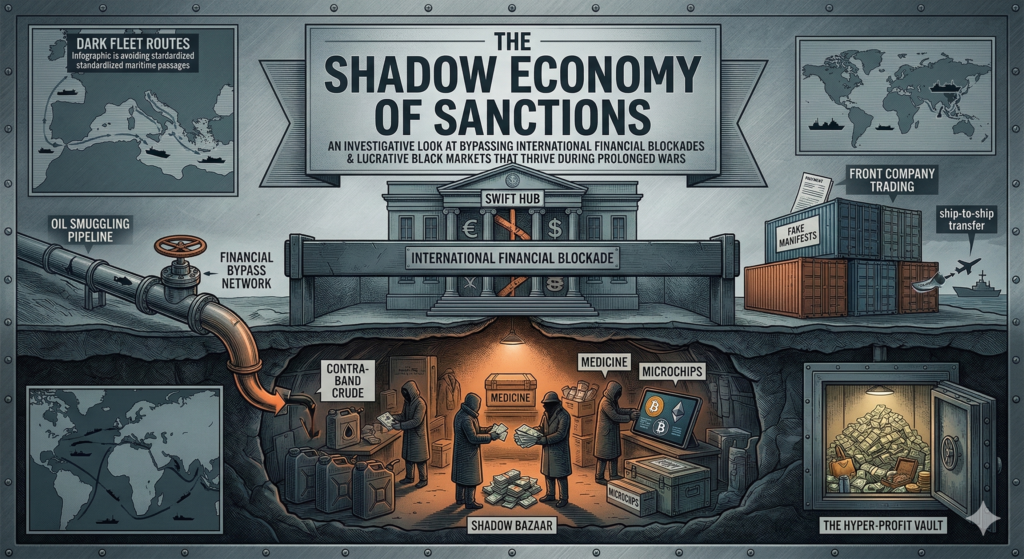
Economic blockades are reinforced by freezing sovereign wealth fund assets and penalizing any third-party institution that dares to trade with the rogue state. So, the impact is immediate: a collapse in imports of critical goods, hyperinflation, and a massive contraction of GDP. Yet, it is within this very pressure cooker that the shadow economy of sanctions is born.
Bypassing the Blockade: Techniques of Illicit Finance
Targeted regimes do not simply capitulate when faced with a financial cutoff. Their survival depends on creating clandestine channels to move money and goods. Investigative analysis reveals several sophisticated sanction evasion techniques that constitute the backbone of the shadow economy.
Cryptocurrencies and Decentralized Finance (DeFi)
Perhaps the most significant digital innovation for the shadow economy of sanctions is cryptocurrency. While not a silver bullet, decentralized digital assets allow states to bypass traditional banking corridors. Rogue regimes can mine Bitcoin using subsidized energy or utilize anonymous cryptocurrencies to pay for imports.
More dangerously, they employ mixing services (like Tornado Cash) to obfuscate the transaction trail and leverage Decentralized Finance (DeFi) platforms, which often lack the Know Your Customer (KYC) requirements of formal banks. States that are completely cut off can build parallel crypto-based architectures for international trade, making bypassing sanctions a technological endeavor. Chain-hopping—instantly converting one crypto asset into another across multiple blockchains—adds a layer of complexity that frustrates enforcement agencies.
Front Companies and Trade Misinvoicing
The most common and effective method for bypassing the blockade involves a complex web of front companies and jurisdictional layering. A targeted state might establish dozens of shell companies in jurisdictions with lax oversight. These companies are owned by proxies or nominees, hiding the true beneficial owner.
These front companies facilitate trade through a process known as trade misinvoicing. When importing essential goods or exporting sanctioned resources (like oil or minerals), customs documents are falsified. Goods are over-invoiced or under-invoiced to move capital out of the country or to hide the source of the transaction. A cargo ship full of sanctioned oil might be transferred from one front company to another multiple times at sea (ship-to-ship transfers), with new, fraudulent bills of lading generated to disguise its true origin, making illicit finance look like legitimate trade.
The Hawala System and Traditional Money Transfer promoting Shadow Economy
While high-tech methods dominate headlines, ancient, trust-based networks are vital for the shadow economy of sanctions. The Hawala system is an informal money transfer method that predates modern banking. Based on a network of brokers (Hawaladars), it allows for the movement of funds without the actual transfer of money. A merchant in the sanctioned country gives cash to a Hawaladar, who contacts a broker in another country.
That broker pays the desired recipient. The brokers settle their debts later through trade or cash smuggling. It operates entirely on trust and is virtually impossible to trace, making it a powerful tool for moving smaller and medium-sized amounts needed for everyday black markets in war.
Wartime Proliferation: Black Markets That Thrive in Conflict
The intersection of sanctions and prolonged warfare creates a hyper-accelerated environment for the shadow economy of sanctions. War increases demand for specialized goods, destroys formal infrastructure, and fosters lawlessness, all of which are catalysts for black market growth.
Smuggling and Contra-Band Trade
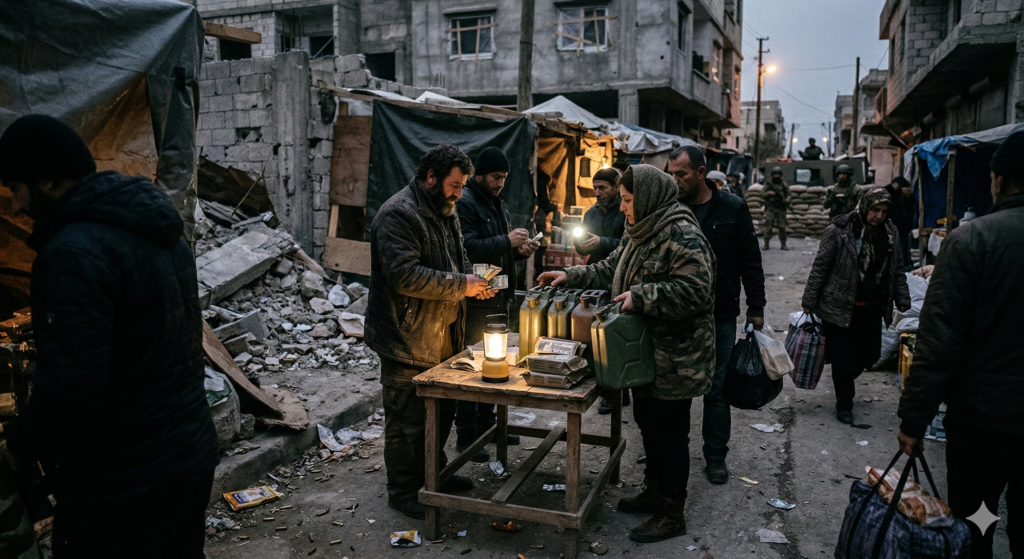
When sanctions combined with an economic blockade cause widespread scarcity, essential goods become contra-band. Fuel, medicine, food, and luxury items command astronomical prices. Smuggling syndicates, often with the tacit approval or direct involvement of corrupt officials, thrive in this vacuum.
Investigative reports frequently show “dark fleets” of aging oil tankers with disabled transponders navigating the world’s oceans, carrying sanctioned crude to eager buyers on the black market. Entire regions can become dominated by smugglers who manage the supply lines that the formal economy can no longer maintain. In prolonged conflicts, the lines between insurgents, criminals, and the state become dangerously blurred as they all participate in and profit from sanctions smuggling.
Weaponry and Dual-Use Technology
The grey and black markets for arms are perhaps the most destabilizing aspect of wartime economies. Sanctions specifically target military hardware and dual-use technology (civilian tech that can be repurposed for military use, such as microchips). Rogue states and insurgent groups utilize the complex corporate structures of the shadow economy to acquire these critical components. End-user certificate fraud is rampant, with goods ostensibly purchased for a harmless civilian project in a neutral country being diverted to the conflict zone, fueling the violence.
Human Trafficking and Resource Exploitation
Economic collapse and state fragility create ideal conditions for the most exploitative black markets. Desperate populations seeking to escape the conflict are co-opted by human trafficking networks, which utilize the same illicit financial channels to launder their proceeds. Furthermore, rouge states often resort to the illicit resource extraction of conflict minerals, timber, or cultural artifacts to generate hard currency, further degrading the environment and fueling the cycle of war.
The Lucrative Nature of the Shadow Economy
The shadow economy of sanctions is not just about survival; it is about super-profits. Because of the inherent risks—seizure of assets, arrest, and reputational damage—the markup on goods and the fees for money laundering services are astronomical. A smuggler moving oil might earn ten times the normal market rate. This extreme profitability attracts sophisticated transnational criminal organizations and fosters deep-seated corruption within the sanctioned regime. Kleptocracy often takes root, with officials personally profiting from the parallel economy they are supposed to regulate, creating a powerful incentive to prolong the very conditions that fuel the black markets in war.
Geopolitical Consequences and the Long-Term Shadow Economy
The existence of a powerful, resilient shadow economy has profound geopolitical consequences. It fundamentally weakens the effectiveness of geopolitical sanctions as a non-kinetic tool. If a nation knows it can survive a financial blockade by pivoting to illicit channels. The intended behavior modification is less likely to occur. Furthermore, it strengthens alternative financial architectures as targeted nations, together with allies and criminal syndicates, work to create payment systems outside the U.S. dollar’s reach (such as China’s CIPS or various cryptocurrency projects). When the war finally ends, these illicit networks do not disappear. They persist as entrenched criminal enterprises that degrade rule of law and facilitate ongoing illicit finance activities, leaving a permanent long-term shadow on the global trade architecture.
Conclusion to Shadow Economy
So, the shadow economy of sanctions is an investigative look at how targeted nations bypass international financial blockades. And the lucrative black markets that thrive during prolonged wars. Comprehensive economic sanctions, while a necessary and powerful tool in the arsenal of non-kinetic warfare, are not a permanent solution. The relentless financial warfare they create forces targeted states into a process of illicit adaptation. By mastering cryptocurrencies, trade misinvoicing, front companies, and traditional trust networks, rogue actors can maintain a lifeline and even prosper. Also, the profitability of this parallel system attracts criminal elements and solidifies Kleptocratic corruption. Ensuring that the shadow economy of sanctions persists as a resilient, dangerous global phenomenon.