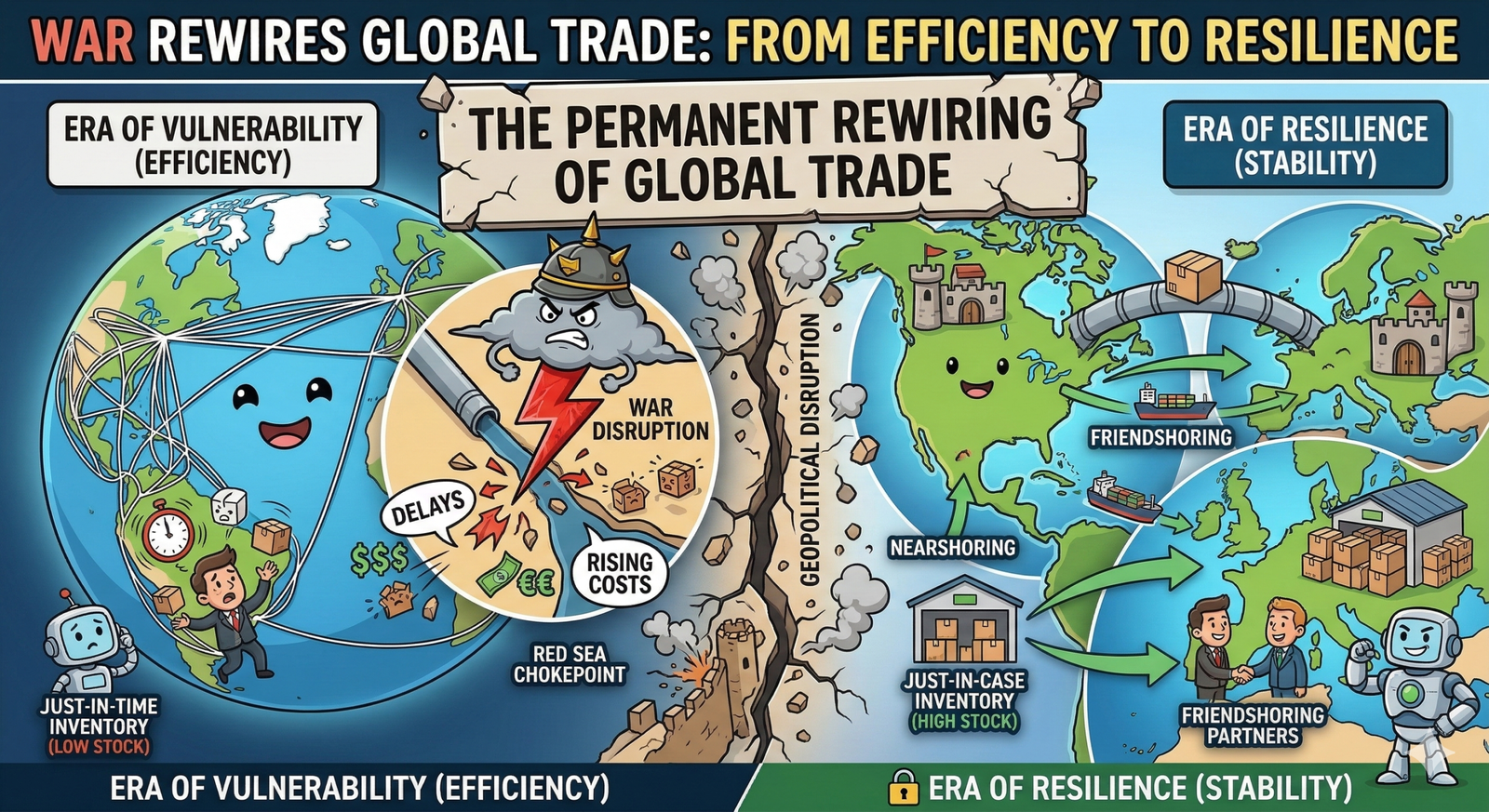
For the past three decades, the global economy operated on a singular, dominant philosophy: efficiency at all costs. Coined “hyper-globalization,” this era was defined by the relentless pursuit of the cheapest labor and materials. Resulting in supply chains that spanned tens of thousands of miles. Corporations adopted a “just-in-time” inventory model. Trusting that massive container ships would navigate peaceful oceans to deliver components exactly when needed. Keeping warehousing costs near zero affecting Global Trade.
Today, that foundational trust is broken.
The illusion of a frictionless global market has been shattered by geopolitical conflicts. Transforming vital shipping routes into contested war zones. As missiles fly and embargoes are enacted, the world is witnessing the permanent rewiring of global trade. We are rapidly transitioning from an era of hyper-globalization to an era of regionalization. Where companies are forced to prioritize localized, resilient supply chains over absolute cost efficiency.
To understand this historic economic pivot, we must examine the vulnerability of maritime chokepoints. The compounding costs of disruption, and the new strategies corporations are deploying to survive.
The Fragility of Maritime Chokepoints
Approximately 80% of the volume of international trade in goods is carried by sea. This massive floating economy relies entirely on a handful of narrow, strategic waterways known as maritime chokepoints.
When global peace is maintained, these chokepoints are miracles of logistics. When conflict erupts, they become the Achilles’ heel of the global economy. A disruption in just one of these narrow straits sends a cascading shockwave of delays. Inflation, and shortages across every continent.
The Black Sea: The Breadbasket Blockade
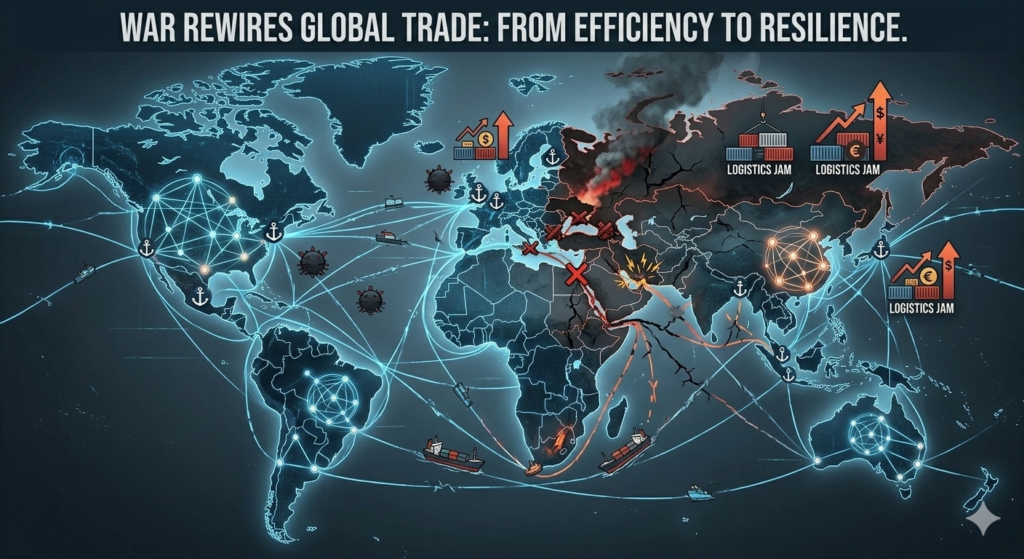
The vulnerability of these routes became glaringly obvious with the onset of the Russia-Ukraine war in 2022. The Black Sea is a critical artery for global agriculture. Serving as the primary export route for Ukrainian and Russian wheat. Corn, and sunflower oil, as well as essential fertilizers.
When naval blockades and sea mines rendered the Black Sea largely impassable for commercial shipping. It did not just affect Eastern Europe; it triggered a global food security crisis. Nations in the Middle East and Africa faced sudden, massive grain shortages, driving up global food inflation. The conflict proved that relying on a single, distant region for critical commodities is an existential risk for importing nations.
The Red Sea and the Suez Canal: The Logistics Nightmare
The crisis escalated further in late 2023 and into 2024 with the spillover of the Middle East conflict into the Red Sea. Houthi militants based in Yemen began launching drone and ballistic missile attacks against commercial vessels navigating the Bab el-Mandeb Strait, the gateway to the Suez Canal.
The Suez Canal typically handles about 12% to 15% of all global trade, representing the fastest maritime route between Asia and Europe. The relentless attacks forced major ocean freight carriers—like Maersk and Hapag-Lloyd—to make a drastic decision: abandon the Red Sea entirely and reroute ships around the Cape of Good Hope at the southern tip of Africa.
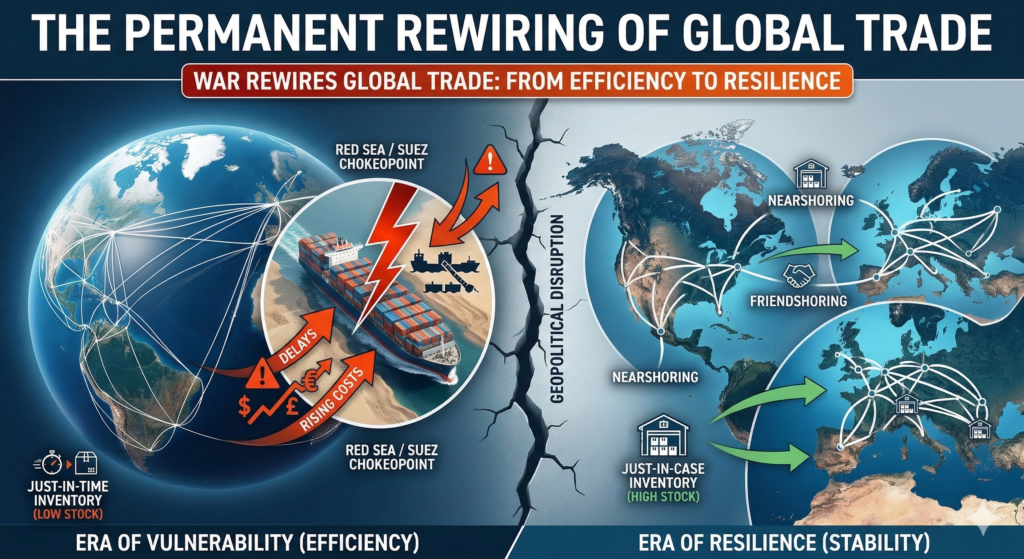
This detour adds approximately 3,500 nautical miles and 10 to 14 days of transit time to a typical voyage from Shanghai to Rotterdam. The economic consequences are severe:
- Skyrocketing Freight Rates: The cost of shipping a standard 40-foot container tripled in a matter of weeks as available shipping capacity was absorbed by longer voyages.
- Fuel and Insurance Costs: Longer routes require millions of dollars in extra fuel, while war-risk insurance premiums for vessels attempting to cross the Red Sea soared to unsustainable levels.
- Manufacturing Pauses: European automotive plants, reliant on parts shipped “just-in-time” from Asia, were forced to halt production lines because the components were suddenly two weeks late.
The Death of “Just-in-Time” and Hyper-Globalization
These intersecting crises have forced a reckoning in corporate boardrooms worldwide. The core premise of hyper-globalization—that geography doesn’t matter as long as labor is cheap—is no longer mathematically or strategically viable.
When a company saves 20% on manufacturing costs by offshoring to a distant factory, but then loses 40% of its revenue because a regional conflict traps its inventory on a ship for a month, the offshore advantage evaporates. The risk premium attached to long, complex supply chains now frequently outweighs the cost savings.
Consequently, the “just-in-time” inventory model is dead. It has been replaced by the “just-in-case” model. Companies are now willing to pay higher warehousing costs to hold surplus inventory, creating a buffer against the next inevitable geopolitical shock.
Building the New Architecture: Resilience and Global Trade
Global trade is not ending; it is mutating. Instead of a single, highly integrated global web, the new architecture of trade is fracturing into distinct, regionalized blocs. Companies are employing several new strategies to build resilient supply chains that can withstand the closure of maritime chokepoints.
1. Nearshoring
Nearshoring involves moving manufacturing closer to the end consumer. Drastically reducing the physical distance products must travel and bypassing vulnerable maritime routes.
- North America: So, the United States is seeing a massive surge of nearshoring to Mexico. By manufacturing in Mexico, companies can move goods into the US via truck or rail. So, entirely avoiding the risks of trans-Pacific shipping. The Panama Canal (which has faced severe drought restrictions), and the Red Sea.
- Europe: So, European companies are increasingly looking to Eastern Europe, Turkey. And North Africa to replace manufacturing bases in East Asia, securing shorter, more defensible supply lines.
2. Friendshoring
Also known as “ally-shoring,” this strategy is driven by the realization that economic dependence on geopolitical adversaries is a national security threat. Friendshoring dictates that supply chains should be concentrated within countries that share similar values and geopolitical alliances. The goal is to ensure that a sudden diplomatic fallout or targeted economic sanctions do not cut off access to critical materials, such as semiconductors, rare earth minerals, or pharmaceuticals.
3. Supply Chain Redundancy
In the era of hyper-globalization, companies often relied on a single “mega-factory” or a single supplier for a crucial component to maximize economies of scale. Today, businesses are actively seeking “N+1” strategies. Even if it costs more, they are contracting with multiple suppliers across different continents. If a factory in Asia goes offline due to a blockade, a secondary factory in South America or Europe can immediately ramp up production to fill the void.
The Economic Reality of the New Era and Global Trade
So, it is essential to recognize that resilience is expensive. The permanent rewiring of global trade carries significant macroeconomic implications.
When manufacturing is moved away from the regions with the absolute lowest labor costs, the cost of producing goods inherently rises. Duplicating supply chains for redundancy requires massive capital expenditure. Holding “just-in-case” inventory ties up billions of dollars in working capital.
Ultimately, this transition acts as a structural, inflationary force. Consumers will likely have to adapt to an era where goods are slightly more expensive and inflation is “stickier” than it was during the peak of hyper-globalization in the 2010s. However, the trade-off is stability. A localized, redundant supply chain guarantees that the shelves remain stocked and hospitals remain supplied, even when the world’s major shipping lanes are blocked by conflict.
Conclusion to Global Trade
So, the map of global commerce is being aggressively redrawn. The era of unquestioned, frictionless trade that characterized the late 20th and early 21st centuries has closed, also replaced by a landscape defined by geopolitical risk and strategic competition. As long as critical maritime arteries remain vulnerable to the whims of regional conflicts, the corporate exodus from fragile, extended logistics networks will only accelerate. The future belongs to those who build for survival, proving that The Permanent Rewiring of Global Trade: Look at how conflicts disrupting critical maritime chokepoints (like the Red Sea or the Black Sea) are forcing companies to abandon hyper-globalization in favor of localized, resilient supply chains.