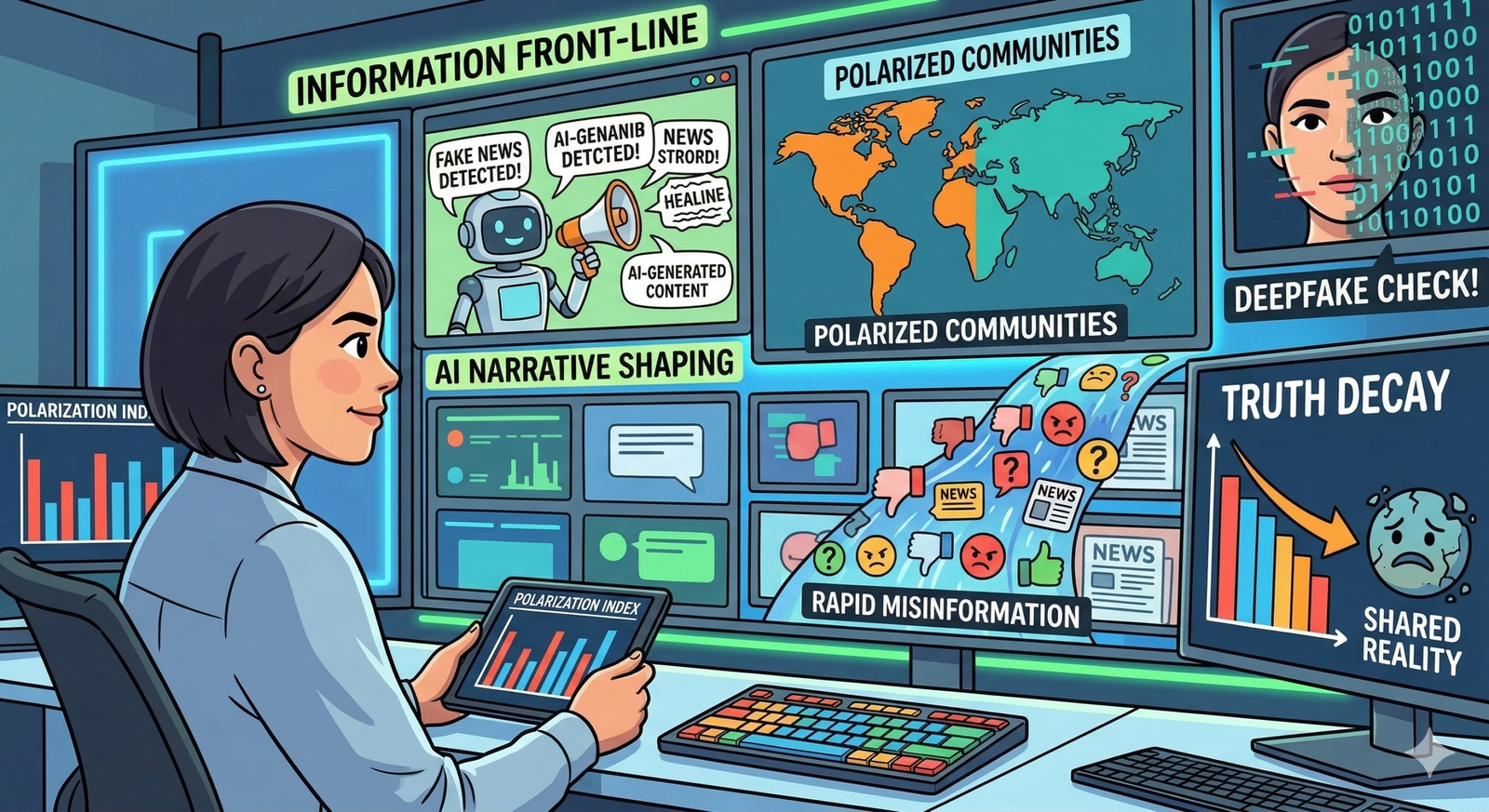
Traditional warfare is fought on land, at sea, and in the air. However, in the 21st century, a new and critically important conflict zone has emerged: the information frontline. This digital battlefield, located within our smartphones and computer screens, is where public perception is shaped, realities are constructed, and communities are mobilized or polarized in real-time.
Modern conflicts, whether geopolitical, political, or social, are now fought simultaneously in the physical world and on digital platforms. The information frontline is defined not by geography, but by attention, algorithms, and narratives. Governments, extremist groups, and political actors are increasingly weaponizing information—using viral social media clips, AI-generated content, and rapid misinformation campaigns—to achieve strategic goals without firing a shot. This article will provide an in-depth analysis of these tactics and their profound impact on society.
The Evolution of Narrative Warfare: Beyond Propaganda
Information warfare is not new. Propaganda has been a staple of conflict for centuries. However, the dynamics of the information frontline differ significantly from historical models. Traditional propaganda was centralized, state-controlled, and disseminated through top-down channels like newspapers and radio. Modern informational warfare is decentralized, participatory, and operates at light speed.
The rise of the internet and social media has democratized the creation and distribution of information. This has empowered citizen journalists and activists, but it has also created an environment where malicious actors can exploit the chaotic flow of information. The goal of modern narrative warfare is often not just to persuade, but to confuse, cause division, and erode trust in institutions and shared realities. This strategy is frequently referred to as cognitive warfare, as it directly targets the human mind and its perception of truth.
Viral Social Media Clips: The Raw Materials of Modern Polarization and Information Frontline
On the information frontline, short-form video content has become one of the most powerful weapons available. Platforms like TikTok, Instagram Reels, and X (formerly Twitter) are optimized for engagement and virality, often prioritizing high-emotion content over context or factual accuracy.
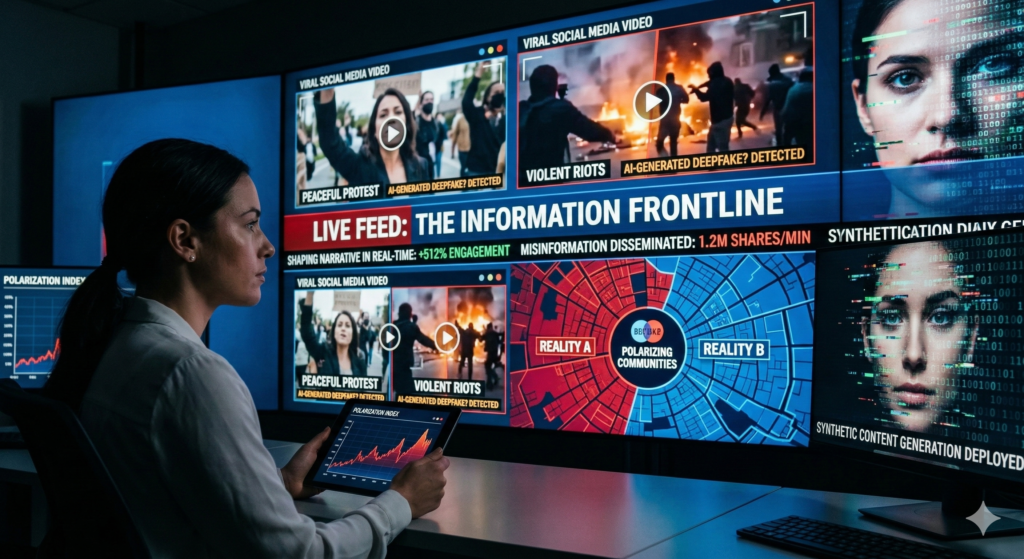
Viral social media clips are highly effective because they are easily consumable, emotionally resonant, and can spread globally within minutes. Malicious actors frequently decontextualize or manipulate these clips to serve a specific narrative. A 10-second video of an event, stripped of what happened before and after, can be presented to support a completely false conclusion.
Furthermore, algorithms play a crucial role in amplifying this content. Social media platforms are designed to keep users engaged, often by serving them content that aligns with their existing beliefs (confirmation bias) and elicits strong emotional responses, particularly anger or outrage. This creates filter bubbles and echo chambers, where individuals are primarily exposed to polarizing information that reinforces pre-existing biases. When weaponized, this dynamic allows for the rapid mobilization of communities based on incomplete or misleading narratives.
The Rise of AI and the Authenticity Crisis
The integration of Artificial Intelligence (AI) into information operations has marked a significant escalation on the information frontline. AI technologies, including generative text models and deepfake audiovisual generation, have drastically lowered the barrier to entry for creating convincing misinformation at scale.
The Power of Deepfakes
Deepfakes—AI-generated synthetic media that accurately mimics the likeness and voice of real people—pose a unique threat. A well-crafted deepfake can show a political leader making a false statement, incite violence, or undermine democratic processes. While still often detectable, the technology is improving rapidly, and the “liar’s dividend” is becoming a significant issue. This concept describes how the mere existence of deepfake technology allows individuals to dismiss genuine, incriminating evidence by claiming it is AI-generated, further eroding trust in all visual information.
Automating Disinformation at Scale
AI is also used to automate the creation and distribution of text-based misinformation. Large Language Models (LLMs) can generate vast quantities of persuasive, context-aware articles, social media posts, and comments in multiple languages. When combined with coordinated bot networks, these AI-driven campaigns can manufacture artificial grassroots support (“astroturfing”) for a particular viewpoint, creating the illusion of consensus and amplifying polarizing narratives faster than fact-checkers can respond.
Rapid Misinformation and the Battle for Real-Time Narratives
Speed is the critical component of warfare on the information frontline. The battle to shape the narrative surrounding an event is often won in the first few hours, long before verifiable facts can emerge. This reality is exploited through the spread of rapid misinformation.
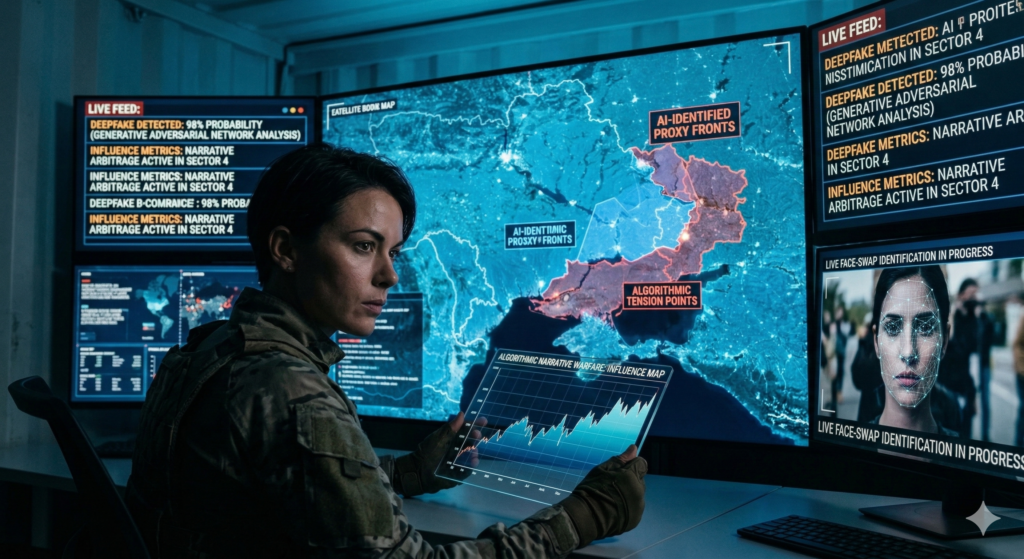
When a major event occurs—such as a natural disaster, a protest, or a military strike—there is often an immediate “information vacuum” as legitimate news organizations work to confirm details. Malicious actors fill this vacuum with speculation, false rumors, and manipulated imagery designed to establish an initial, emotionally charged narrative.
By the time fact-checkers are able to debunk these false claims, the initial narrative has often already taken root. Having been amplified by algorithms and shared by well-meaning individuals who were exposed to it first. This constant barrage of conflicting, rapidly shifting information contributes to “truth decay”—a condition where facts are increasingly disregarded, and public discourse is driven primarily by opinion and belief.
The Consequences: Parallel Realities and Polarized Communities of Information Frontline
The weaponization of the information frontline has profound and dangerous real-world consequences. The primary outcome is the polarization of communities, as individuals increasingly inhabit parallel informational realities.
When communities receive vastly different versions of reality. Driven by polarized social media clips and AI-amplified misinformation, shared understanding and compromise become impossible. Trust in shared institutions—including the media, academia, and democratic processes—is severely eroded. This environment provides fertile ground for radicalization, political instability, and even violence.
Moreover, the constant exposure to high-outrage, anxiety-inducing content on the information frontline can lead to compassion fatigue, skepticism towards all information, and a sense of political powerlessness among the general public.
Conclusion: Information Frontline
The information frontline is a permanent fixture of the modern geopolitical and social landscape. As technologies like AI continue to advance, the tactics of narrative warfare will become increasingly sophisticated and pervasive. Understanding how viral social media, deepfakes, and rapid misinformation are weaponized is crucial for navigating this new reality.
Countering these threats requires a multi-faceted approach. While platforms must improve content moderation and algorithmic transparency, and governments must develop appropriate regulations. The most critical defense is digital literacy and critical thinking. Individuals must learn to approach online information with healthy skepticism. To verify sources before sharing, and to recognize the emotional manipulation tactics that are common on the information frontline. Only through a combination of technological defense and an informed, resilient populace can society mitigate the polarizing and destructive impacts of weaponized information in the digital age.