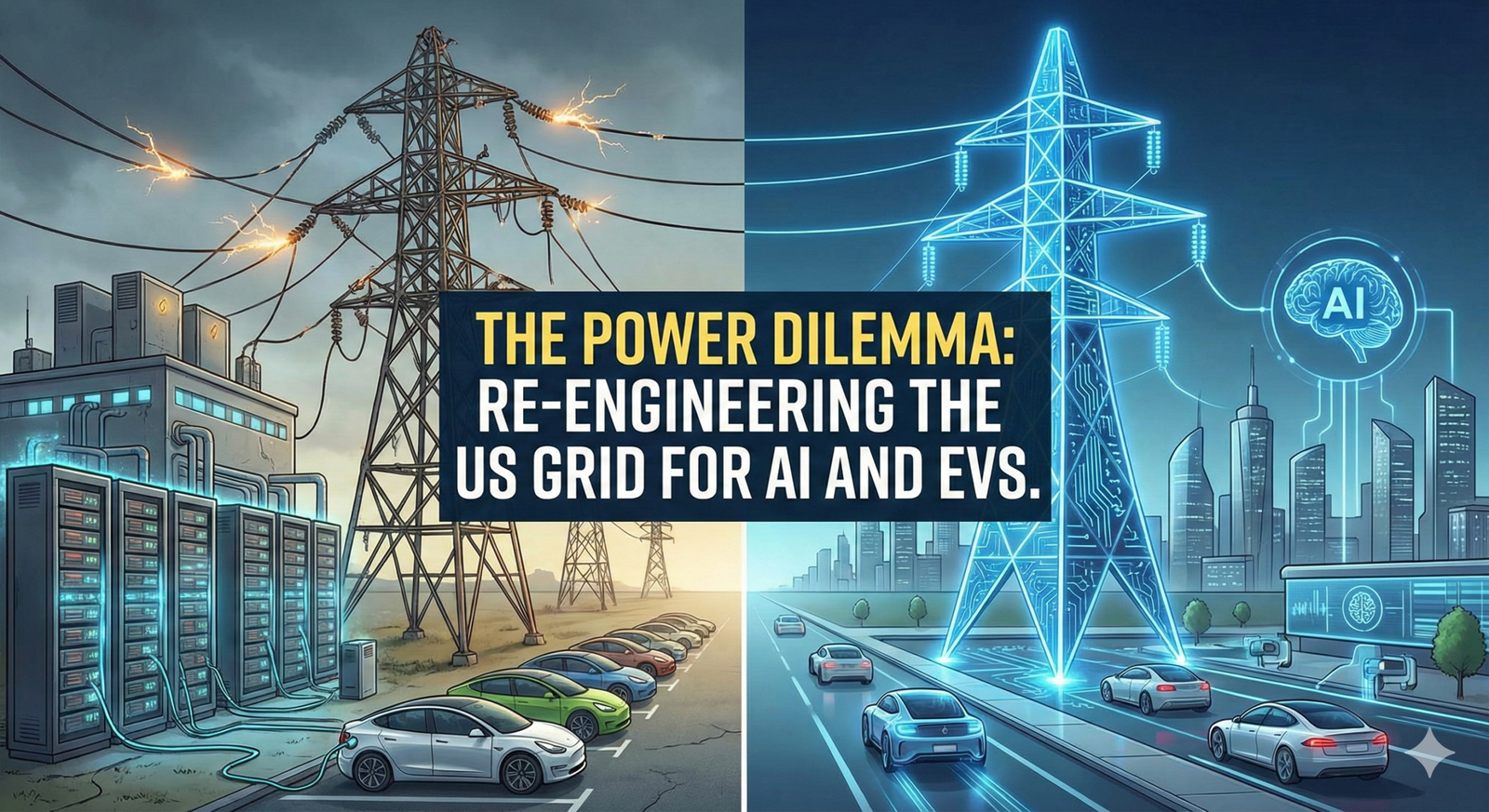
The United States electrical grid is facing an unprecedented existential crisis. It’s a dilemma born of success and innovation. We are simultaneously undergoing two massive societal transformations: the rapid digitization of everything via artificial intelligence, and the complete decarbonization of transportation through electric vehicles.
Both revolutions are non-negotiable for economic growth and climate goals. Yet, they both rely on the same finite resource: electricity.
So, the US power grid, a patchwork system largely designed in the 20th century for predictable loads. And fossil fuel generation, is creaking under the strain of the 21st century. So ,we cannot simply build more coal plants to meet this demand. So, the solution requires a fundamental hardware overhaul. We must re-engineer the grid’s nervous system using advanced materials designed to handle immense power with extreme efficiency.
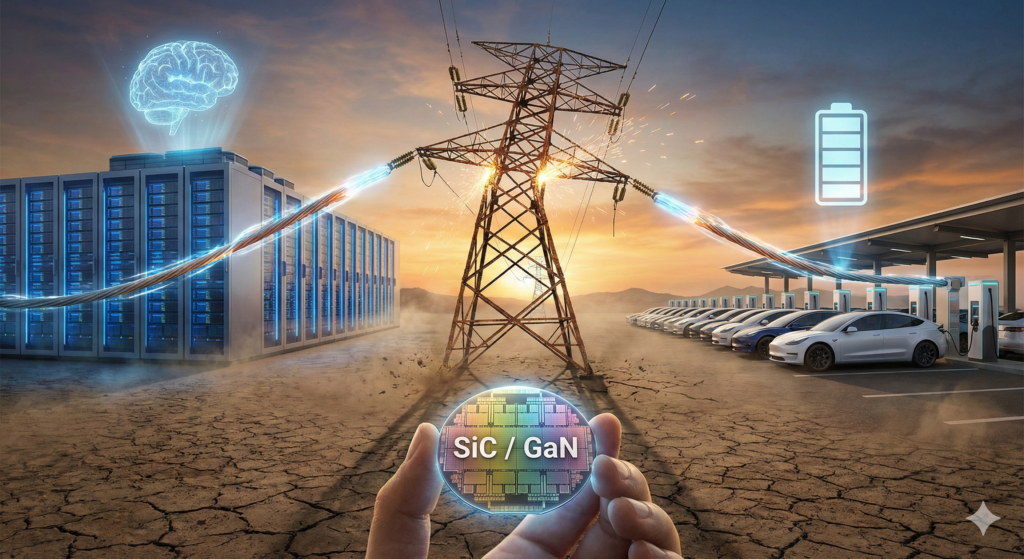
This is the story of the new “power dilemma” and the cutting-edge semiconductor innovations—specifically Silicon Carbide and Gallium Nitride. So, that are being deployed to save the US energy infrastructure from collapsing under the weight of the future.
The Twin Titans of Demand: AI and EVs
To understand the scale of the challenge, we must look at the sheer appetite of the two forces hitting the grid simultaneously.
The Insatiable AI Appetite from the US grid
Data centers have always been power-hungry, but generative AI has changed the equation entirely. Training large language models requires massive server farms running thousands of high-performance GPUs at full throttle for weeks or months.+1
According to recent analysis, data center power demand in the US is projected to grow exponentially. Some estimates suggest AI could consume as much electricity as entire small nations within a few years. Unlike traditional internet traffic which fluctuates, AI training loads are intense, constant, and concentrated in specific geographic hubs like Northern Virginia or Silicon Valley, putting immense localized localized stress on transmission lines.
The Electric Vehicle Surge
Simultaneously, the US is transitioning away from internal combustion engines. As millions of Americans plug in their EVs at night when they return from work, they create a massive “peak demand” event.
Furthermore, the push for long-haul electric trucking will require charging depots that draw as much power as a small town whenever a fleet plugs in. The existing grid infrastructure, from neighborhood transformers to high-voltage transmission towers, was never modeled for this level of coincident demand.
The Limit of Legacy Silicon
If we try to meet this combined demand using today’s standard electrical hardware, we will fail. The core problem lies in efficiency and heat.
For decades, the power electronics that convert electricity (from AC to DC, or stepping voltages up and down) have relied on traditional silicon. While cheap and abundant, silicon hits physical limits when handling high voltages and currents.+1
When traditional silicon converts power—for example, in an EV charger changing grid AC power to battery-ready DC power—it loses a significant percentage of that energy as waste heat. In a high-demand scenario involving AI data centers and EV fleets, that waste heat translates to billions of dollars in lost energy and requires massive, energy-sucking cooling systems to prevent equipment failure.
We need materials that can handle higher power densities without melting down.
Enter the Game Changers: Wide-Bandgap Semiconductors
The solution to re-engineering the US grid lies in “Wide-Bandgap” (WBG) semiconductors. These are advanced materials that can operate at much higher voltages, temperatures, and frequencies than traditional silicon, with significantly less energy loss.
Two materials are leading this US-led innovation charge: Silicon Carbide (SiC) and Gallium Nitride (GaN).
These aren’t just incremental upgrades; they are generational leaps in power electronics that are rapidly becoming the backbone of the modern grid.
Silicon Carbide (SiC): The High-Voltage Heavy Lifter
So, silicon Carbide is extremely robust. It excels at handling high voltages (800V to 1200V+) and high temperatures. This makes it the ideal material for heavy-duty applications.+1
- Revolutionizing EV Fast Charging: To reduce “range anxiety,” the US needs a network of ultra-fast DC chargers, capable of charging a car in 15-20 minutes. These chargers require immense power throughput. SiC-based power modules allow these chargers to be smaller, more reliable, and significantly more efficient, pushing more power into the car battery with less heat loss at the charging station.
- EV Powertrains: SiC is also being adopted inside the vehicles themselves. By using SiC in the car’s main inverter, automakers can extend range by 5-10% using the same battery pack because less energy is wasted during acceleration.
Gallium Nitride (GaN): The Efficiency Speed Demon
While SiC handles brute force high voltage, GaN is prized for its switching speed and hyper-efficiency in smaller packages.
- Data Center Power Supplies: In AI server racks, space is at a premium and heat is the enemy. GaN transistors can switch power much faster than silicon, allowing for power supplies that are drastically smaller and cooler. This reduces the immense air conditioning load required by AI data centers, freeing up grid capacity for actual computing.+1
Stabilizing the Renewable US Grid
The grid re-engineering isn’t just about consumption; it’s also about generation. The US is rapidly deploying solar and wind energy to displace fossil fuels.
Solar panels produce DC power; the grid runs on AC. Wind turbines produce wild AC that needs rectifying. Connecting these intermittent sources to the grid requires massive “inverters.”+1
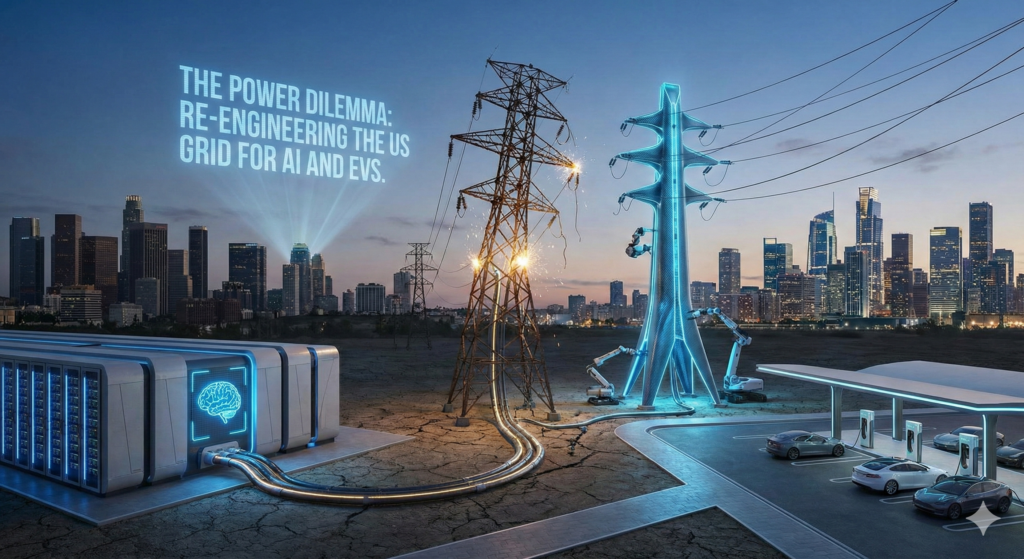
Historically, these inverters were bulky and inefficient. By utilizing SiC technology, utility-scale solar inverters are becoming far more efficient, operating at higher voltages. This means more of the sun’s energy actually makes it onto the grid, and the equipment is more resilient to temperature fluctuations in places like the Mojave Desert. These advanced semiconductors are the critical link ensuring reliable integration of renewables at a massive scale.
The US Context: A Strategic Imperative
The transition to WBG semiconductors is not just an engineering challenge; it is a national strategic imperative for the United States.
Relying on foreign supply chains for the foundational hardware of the 21st-century power grid creates unacceptable national security risks. Recognizing this, the US government, through initiatives like the CHIPS and Science Act, is heavily incentivizing domestic manufacturing of these advanced materials.
Companies like Wolfspeed (in New York and North Carolina) and others are building massive fabrication plants to produce SiC wafers domestically. This reshoring effort ensures that the hardware powering US AI leadership and the EV transition is built on American soil, securing the supply chain against geopolitical shocks.
Conclusion to the US grid
The United States cannot have a 21st-century economy running on 20th-century power infrastructure. The combined demand shock of the AI revolution and the electrification of transport creates a power dilemma that traditional methods cannot solve.
We are past the point where efficiency is merely a “nice to have” feature for cost savings. Efficiency is now the only way to ensure grid reliability and avoid catastrophic stalling of economic progress. The adoption of wide-bandgap semiconductors like Silicon Carbide and Gallium Nitride represents the necessary hardware re-engineering of the American energy landscape. By replacing legacy silicon with these advanced materials, the US is not just patching an old grid; it is building a new, resilient energy nervous system capable of powering the future.