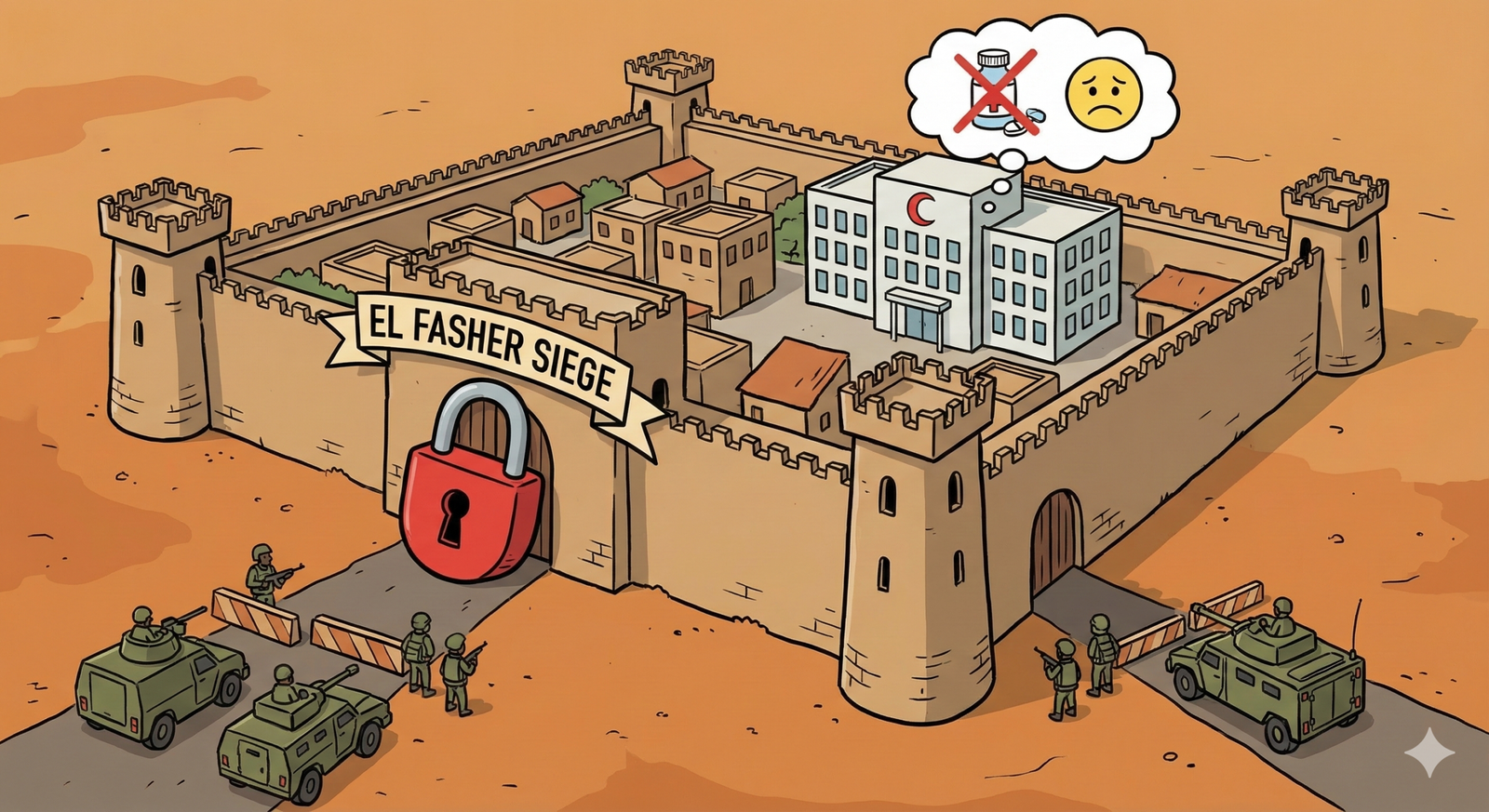
As the sun rises over the Sahel, it illuminates a city that has become a living testament to human resilience and the cruelty of modern warfare. El Fasher, the capital of North Darfur and once a bustling hub for trade and humanitarian aid. Is now entering a grim milestone: the eighteenth month of a suffocating siege called the Siege of El Fasher.
Since late 2024, the city has been the focal point of the brutal civil war between the Sudanese Armed Forces (SAF) and the paramilitary Rapid Support Forces (RSF). While the world’s attention has often drifted elsewhere, the siege of El Fasher has steadily intensified, transforming from a military blockade into an engineered humanitarian apocalypse.
This deep dive examines the mechanics of this prolonged encirclement and focuses on its most devastating consequence. The total, calculated destruction of the healthcare system serving millions of trapped civilians.
The Strategic Stranglehold: Eighteen Months of Encirclement of Siege of El Fasher
To understand the catastrophe, one must understand the strategic importance of El Fasher. For the first year of the Sudan conflict (2023-2024). El Fasher remained a relative sanctuary and the only Darfur state capital not under RSF control. It was the logistical backbone for international aid organizations trying to service the entire Darfur region.
The siege began in earnest around the autumn of 2024. The RSF, having consolidated power in West, Central, and South Darfur, turned its full might toward the north. The goal was clear: complete domination of Darfur.
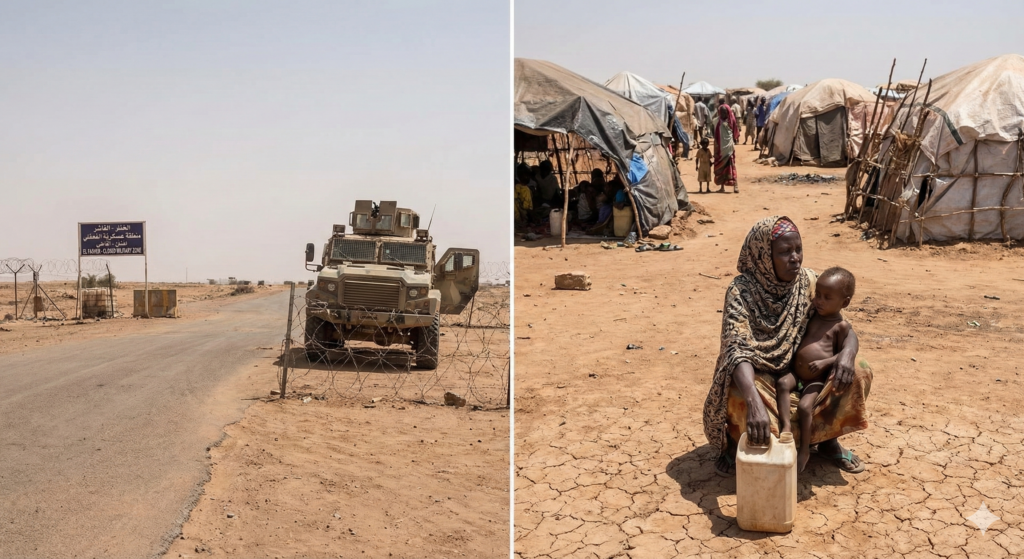
Over the past 18 months, the noose has tightened systematically. The siege was not a single event but a slow progression of asphyxiation.
- Cutting the Arteries: Initial phases involved RSF units seizing key checkpoints along the main roads leading east to Port Sudan and south to Nyala. Commercial convoys were taxed, looted, or destroyed.
- The Artillery War: By early 2025, the conflict shifted to daily shelling. RSF positions on the city’s periphery began indiscriminate bombardment of residential neighborhoods, markets, and, crucially, infrastructure.
- Total Blockade: As of March 2026, nothing moves in or out of El Fasher without enormous risk. The SAF garrison remains trapped inside, supplied occasionally by desperate airdrops that often miss their marks. For the estimated 1.5 million civilians inside the pocket—including vast numbers of internally displaced persons (IDPs) who fled earlier violence—there is no escape.
The siege of El Fasher has become a medieval tactic applied with modern weaponry: starve the defenders into submission, regardless of the civilian cost.
The Anatomy of a Health Collapse
The most harrowing aspect of the siege is not the fighting itself, but the silent death taking place in what remains of the city’s medical facilities. The North Darfur health crisis is no longer a crisis; it is a complete systemic collapse.
Before the war, El Fasher was the medical hub for the region. It hosted the main teaching hospital, specialized pediatric centers, and international NGO clinics. Today, these facilities are graveyards of medicine.
The Targeting of Care
Healthcare has not been accidental collateral damage; it has been a target. Over the last 18 months, artillery fire has repeatedly struck major facilities like the South Hospital and the Saudi Maternity Hospital.
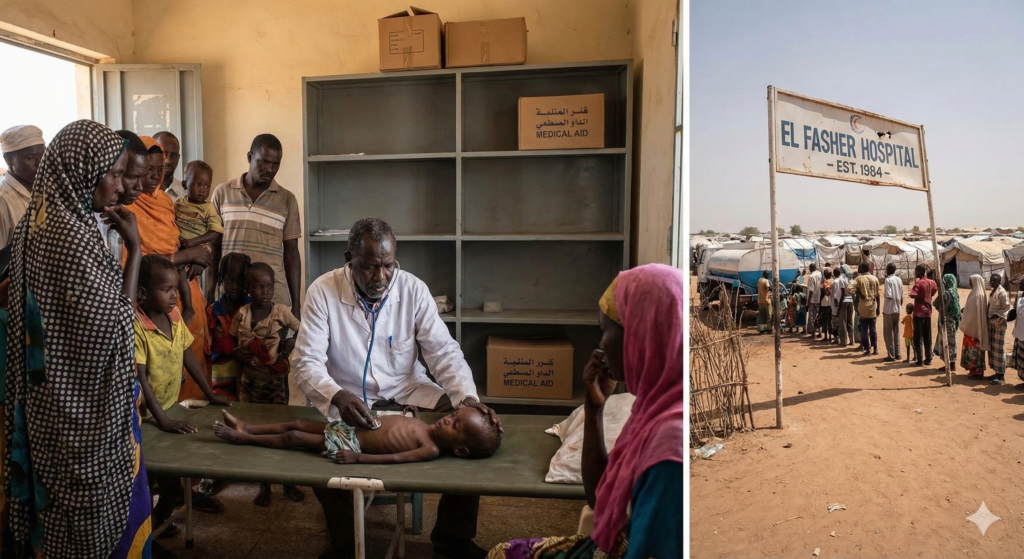
These attacks serve a dual purpose: they demoralize the population and force an exodus of terrified medical staff. Doctors and nurses have been killed in the shelling, assassinated for their ethnicity, or have fled out of sheer self-preservation. The few Sudanese medical heroes remaining are working in conditions that defy description.
Medicine Cabinet Zero
A deeper look into the operating rooms reveals a horror movie scenario. The blockade means essential medical supplies have not reached El Fasher in meaningful quantities for over a year.
- Surgical nightmares: Surgeons are performing life-saving amputations on shelling victims without general anesthesia. Ketamine stocks ran out months ago. There are reports of medical staff using household vinegar as an antiseptic because iodine is unavailable.
- The antibiotic cliff: Simple infections from shrapnel wounds are turning gangrenous and fatal because basic broad-spectrum antibiotics are nonexistent.
- Maternal mortality spike: C-sections, once routine, are now death sentences. The lack of sterile equipment, blood bags for transfusions, and reliable electricity (due to a total lack of fuel for generators) has sent maternal mortality rates soaring back to levels not seen in a century.
Organizations like Médecins Sans Frontières (MSF), which have heroically maintained a presence, have issued desperate pleas. Their statements over the last year chronicle a descent into hell, noting that they are often the only thing standing between the population and total medical void, yet their convoys remain blocked by RSF checkpoints and bureaucratic obstruction by SAF authorities in Port Sudan.
Beyond the Bullets: Famine and Disease
The health crisis is compounded by severe malnutrition, creating a deadly feedback loop. A starving body cannot fight infection, and a sick body cannot absorb nutrients.
The siege has cut off food supplies to the massive displacement camps surrounding the city, such as the infamous Zamzam camp. Already facing famine conditions in 2024, these camps are now zones of slow death in 2026.
The lack of fuel means water pumps have failed. People are forced to drink from stagnant, contaminated sources. The predictable result has been outbreaks of cholera and acute watery diarrhea, which are tearing through the weakened population of children and the elderly. In the absence of rehydration salts or IV fluids, these treatable diseases are mass killers.
The El Fasher humanitarian disaster is characterized by parents forced to watch their children die not from bullets, but from hunger and preventable disease, trapped behind a ring of steel.
Conclusion: Siege of El Fasher
As we mark 18 months of the siege of El Fasher, the situation has moved beyond a “crisis” point. It is a sustained atrocity. The international community’s response—plagued by distracted diplomacy and toothless condemnations—has failed the people of North Darfur.
The encirclement of the city is proof that the horrors of the early 2000s Darfur genocide have returned, reincarnated in a new, perhaps deadlier form. The weapon is not just the Janjaweed fighter on horseback, but the calculated denial of insulin, antibiotics, and food.
Unless immediate, forceful action is taken to break the blockade and establish protected humanitarian corridors, the fall of El Fasher will not just be a military defeat for the SAF. It will be remembered as the moment the world allowed a population of over a million people to die in plain sight, succumbing to injuries and illnesses that modern medicine cured decades ago. The siege must end, or El Fasher will become a vast tomb.