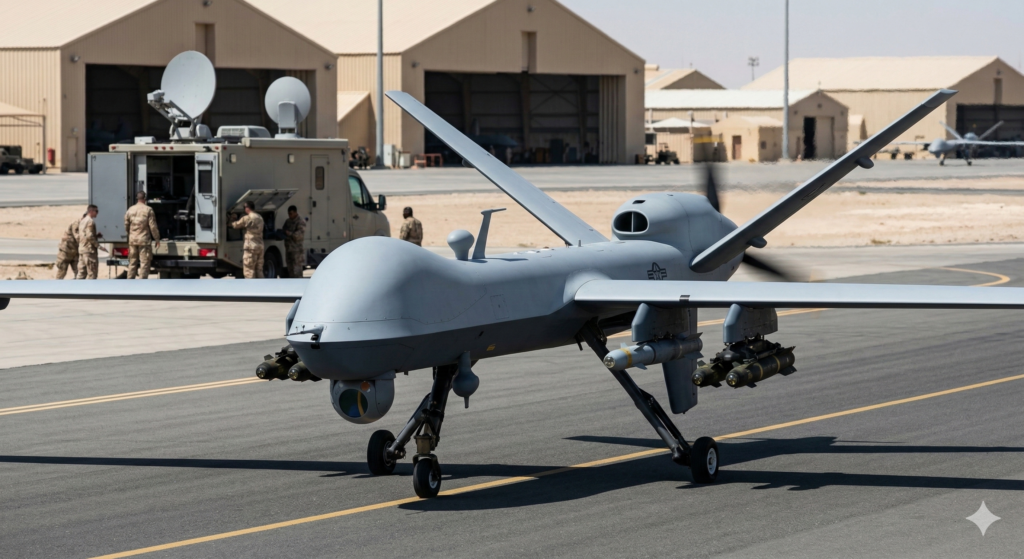
So, for the first two decades of the 21st century, the term “drone warfare” evoked images of multi-million-dollar, school-bus-sized aircraft like the MQ-9 Reaper. These systems, costing upwards of $30 million each, were the exclusive domain of global superpowers, used for precision strikes and high-altitude surveillance in uncontested airspace. Today, that paradigm has been entirely shattered by Drone Economy.
We have entered the era of the “drone economy.” The battlefields of Eastern Europe and the maritime chokepoints of the Middle East have proven that the future of warfare does not belong solely to stealth bombers and aircraft carriers. Instead, it is being dictated by cheap, mass-produced unmanned aerial vehicles (UAVs) built from commercial off-the-shelf parts. This proliferation of accessible, lethal technology has permanently altered military strategy, leveling the playing field and allowing smaller nations and non-state actors to bleed traditional military giants.
The Rise of the FPV: Tactical Innovation on a Budget
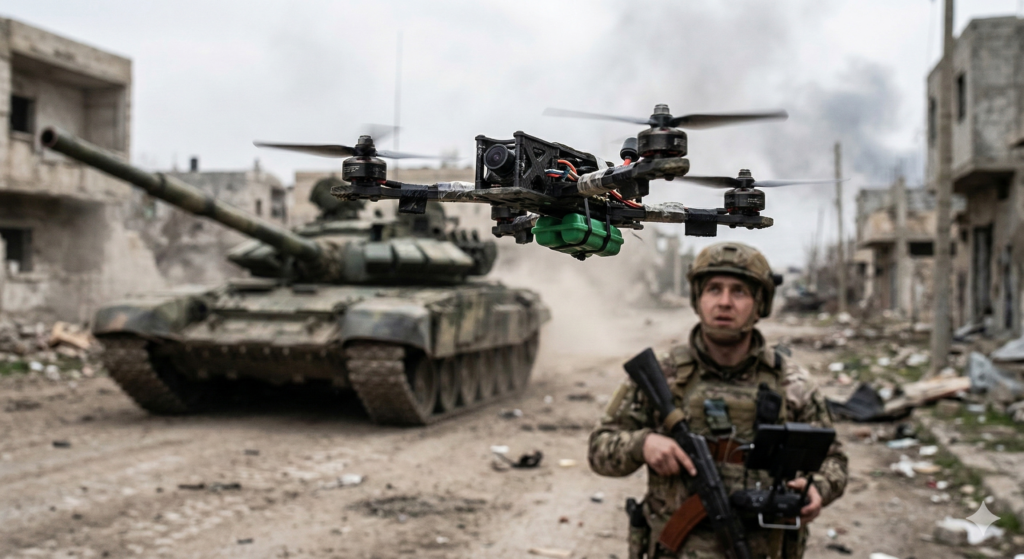
So, the most profound shift in recent military strategy has been the weaponization of First-Person View (FPV) drones. Originally popularized by civilian hobbyists and drone racing leagues, these small quadcopters are fast, highly maneuverable, and remarkably cheap—often costing between $200 and $500 to assemble.
Also, in conflicts like the Russia-Ukraine war, these commercial platforms have been retrofitted with rocket-propelled grenades (RPGs) or custom explosive payloads to act as precision-guided loitering munitions. The tactical advantages are staggering:
- Precision Targeting: Piloted by operators wearing virtual reality headsets. FPV drones can be flown directly into the open hatches of tanks. Through the windows of bunkers, or into the vulnerable radar dishes of air defense systems.
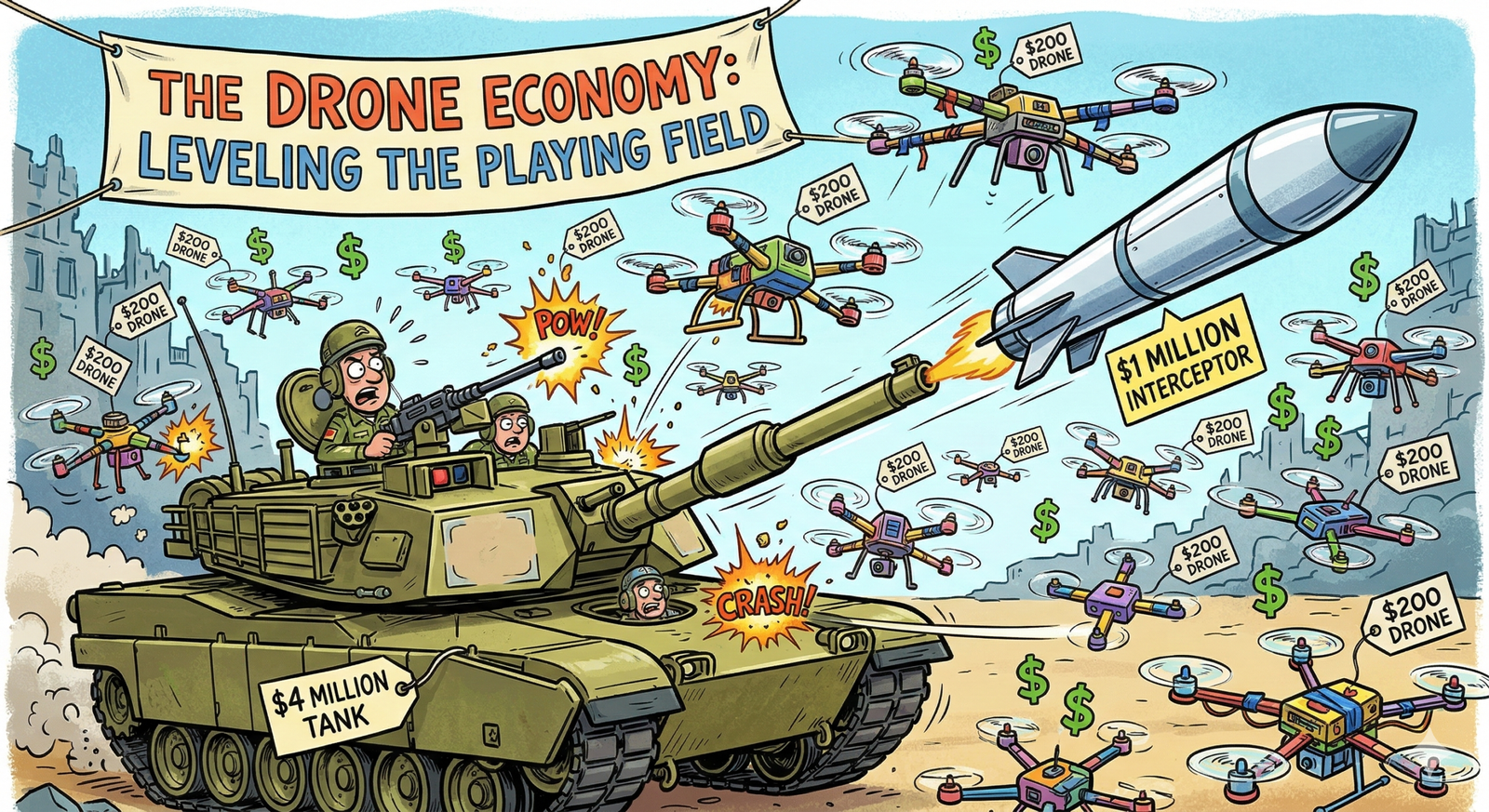
- Mass Saturation: Because they are so inexpensive, they can be deployed in massive numbers. If a military loses ten FPV drones to electronic jamming but the eleventh destroys a $4 million main battle tank, the return on investment is undeniable.
- Rapid Iteration: Unlike traditional defense procurement, which takes years to field a new weapon system, the drone economy moves at the speed of a tech startup. When adversaries deploy new signal jammers, drone engineers simply solder on new frequency-hopping antennas in frontline trenches within days.
Cost-Exchange Asymmetry: Breaking the Bank of Superpowers
The most terrifying aspect of the drone economy for traditional military giants is the brutal mathematics of “cost-exchange asymmetry.” Traditional militaries are built around exquisite, expensive platforms protected by equally expensive interceptors. Mass-produced UAVs turn this economic model upside down.
So, consider the recent naval engagements in the Red Sea. Houthi militants have utilized swarms of cheap, one-way attack drones to harass commercial shipping and challenge Western naval armadas. When a U.S. Navy destroyer detects an incoming hostile drone, it must neutralize the threat to protect the crew and the multi-billion-dollar warship. To do so, the ship often fires an SM-2 or SM-6 interceptor missile.
The economic reality of this exchange is jarring: a superpower is forced to fire a $2.1 million advanced interceptor missile to shoot down a drone made of fiberglass and moped engines that cost roughly $2,000 to build. Even when the superpower successfully intercepts every target, the attacker wins the economic war of attrition. The drone economy allows lesser-funded adversaries to rapidly deplete the multi-million-dollar munitions stockpiles of their significantly wealthier opponents.
From Tactical Nuisance to Strategic Strike
Initially, cheap drones were viewed as tactical tools—useful for front-line skirmishes but incapable of achieving strategic, war-altering objectives. That assumption is now obsolete. Mass-produced UAVs are increasingly doing the job of expensive cruise missiles, striking deep into enemy territory to disrupt logistics and command infrastructure.
A prime example is Ukraine’s “Operation Spiderweb” in mid-2025. Moving beyond short-range tactical strikes, operatives smuggled cheap FPV drones into Russian territory. Launching from disguised civilian trucks, a synchronized swarm of over 100 cheap drones struck multiple strategic airbases deep inside Russia. For the cost of a few luxury cars, this operation reportedly damaged or destroyed several prized strategic bombers and surveillance aircraft, inflicting billions of dollars in damage.
This hybrid model of warfare—blending stealth logistics with cheap, lethal UAVs—proves that a nation no longer needs a fleet of stealth bombers to project power and cripple an enemy’s strategic assets.
The Next Frontier: AI and Autonomous Swarms of Drone Economy
The Achilles’ heel of the current drone economy is the human operator. FPV drones require a constant, stable radio link between the pilot and the UAV. Traditional militaries have countered this by deploying massive Electronic Warfare (EW) complexes designed to jam these radio frequencies. Causing the drones to drop from the sky. Furthermore, training thousands of skilled pilots represents a massive logistical bottleneck.
The solution, which is currently unfolding in real-time, is the integration of Artificial Intelligence (AI).
By equipping cheap drones with basic AI and machine vision (similar to the software that powers facial recognition on smartphones), the reliance on a human pilot is severed. The operator simply locks a target on a screen. And the drone flies the final terminal phase of the attack autonomously. Because the drone no longer needs to communicate with a pilot, electronic jamming becomes useless.
Furthermore, this software enables “drone swarms.” Instead of one pilot controlling one drone, a single operator can command a flock of dozens of UAVs that communicate with one another. Autonomously navigating terrain and coordinating strikes to overwhelm enemy air defenses.
The Doctrine Shift: The End of the Heavy Tank?
The sheer density of cheap drones in the airspace above modern battlefields has created a devastating “kill zone” extending miles behind the front lines. It is nearly impossible to move heavy, concentrated armor without being instantly detected by reconnaissance drones and subsequently destroyed by FPV kamikazes.
This reality is forcing the world’s premier militaries to radically rewrite their combat doctrines. The traditional emphasis on massive columns of heavy tanks is giving way to a new “light cavalry” paradigm. Militaries are increasingly utilizing dirt bikes, all-terrain vehicles (ATVs), and small, dispersed infantry squads. These platforms lack the thick armor of a tank, but they possess the speed. Agility, and small thermal signatures necessary to evade the ever-present gaze of cheap aerial drones. The drone economy has made hiding impossible, forcing armies to trade heavy armor for speed and dispersion.
Conclusion to Drone Economy
The character of war has fundamentally and irreversibly shifted. The barrier to entry for lethal, precision airpower has plummeted from tens of millions of dollars to the cost of a household appliance. As the drone economy continues to mature. Driven by rapid commercial innovation, open-source software, and AI integration. The historical dominance of traditional military giants will be continually challenged. In the wars of the future, victory will not necessarily belong to the nation with the most expensive aircraft. But to the one that can build, adapt, and deploy the most relentless swarm.