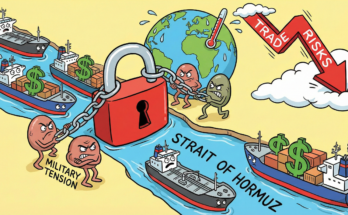
The events of early March 2026 have jolted the global financial architecture awake. The escalating conflict in the Middle East, culminating in severe disruptions around the Strait of Hormuz. Has materialized the market’s worst nightmare: a sudden, violent energy supply shock. As Brent Crude prices shattered previous records and stock indices globally hemorrhaged value, a critical question has emerged amidst the chaos. In an era defined by geopolitical fracture and returning inflation fears, where do investors hide in a Digital Safe Haven?
Traditional safe havens like gold and the US dollar have seen predictable inflows. However, the spotlight is fiercely focused on the digital realm. The narrative of Bitcoin as “digital gold”—an uncorrelated hedge against systemic risk—is facing its most significant real-world stress test. As traditional market volatility spikes. Institutions and retail traders alike are forcing a re-evaluation of cryptocurrency’s role in a diversified portfolio. Are we witnessing a definitive rotation into digital safe havens. Or is the crypto market proving just as vulnerable to the panic gripping the broader financial world?
The Anatomy of the March 2026 Energy Shock
To understand the current market dynamics, we must first appreciate the scale of the trigger event. The partial closure of critical Middle Eastern shipping lanes has choked off a significant percentage of global daily oil transit. The immediate reaction was visceral: energy futures skyrocketed. Reigniting fears of cost-push inflation that many central banks believed they had tamed.

For financial markets, energy crises are particularly pernicious because they act as a universal tax on growth. Rising fuel costs bleed into logistics, manufacturing, and agricultural production, squeezing corporate margins and denting consumer spending power simultaneously. The swiftness of this crisis left little time for preparation. Forcing a sudden, violent repricing of risk across all asset classes. It is against this backdrop of macroeconomic dread that the crypto market’s reaction must be judged.
Traditional Markets Reeling and the Inflation Spectre
The fallout in traditional finance (TradFi) was immediate. The S&P 500 and Nasdaq Composite erased months of gains within days as the reality set in: the energy shock likely takes rate cuts off the table for the Federal Reserve and the ECB.
Investors are now grappling with the specter of “stagflation”—stagnant economic growth combined with high inflation. In such an environment, high-growth tech stocks and indebted companies become toxic. The resulting liquidity crunch in equities often leads to forced selling across the board as margin calls come due.
This is the crux of the current dilemma. When traders need liquidity desperately to cover losses in traditional markets, they sell whatever they can. Historically, crypto, being highly liquid and trading 24/7, has often been the first asset class dumped during “risk-off” panic events. The initial hours of the March 2026 crisis saw exactly that—a sharp correlation where Bitcoin plunged alongside the S&P. However, the subsequent days have shown a fascinating divergence.
Bitcoin as “Digital Gold”: The Hedge Thesis Tested
The primary argument for Bitcoin as a digital safe haven rests on its scarcity (the 21 million hard cap) and its theoretical independence from any central bank’s monetary policy or any single nation’s geopolitical fate. In a world where fiat currencies are being devalued by inflation and weaponized through sanctions. A neutral, decentralized store of value becomes highly attractive.
Following the initial knee-jerk sell-off at the start of the crisis, we began to see a decoupling. As news of the energy blockade solidified and oil prices continued their upward march, Bitcoin and select large-cap assets began to find support, even as equities continued to slide.
This suggests a bifurcation in investor psychology. Short-term speculators flushed out their positions early. However, longer-term holders and macro-focused investors appear to be stepping in, viewing the energy crisis as a catalyst for prolonged fiat currency debasement. If central banks are forced to print money to subsidize energy costs or bail out faltering economies, the “hard money” properties of Bitcoin become a paramount hedge.
The Institutional Pivot vs. Retail Reaction
The reaction to this crisis highlights the evolving maturity of the crypto market, driven largely by institutional participation that didn’t exist five years ago.
The Institutional View: Hedge funds and family offices, acutely aware of geopolitical risk finance, are increasingly viewing a non-zero allocation to crypto as mandatory portfolio insurance. Data from major OTC (Over-The-Counter) desks suggests that during the peak of the recent stock market volatility, institutional buy orders for Bitcoin increased. They are not buying for 100x gains; they are buying for capital preservation against systemic shock.
The Retail Flight: The retail sector has shown a different reaction function. Faced with soaring gas prices and plummeting retirement accounts, many retail investors have retreated to safety within the crypto ecosystem itself: stablecoins. Market capitalization for USDT and USDC surged in early March as traders exited volatile altcoins but chose to keep their capital on-chain rather than off-ramping back into the traditional banking system. This indicates a sticky belief in the digital asset ecosystem, even if risk appetite has temporarily vanished.
The Volatility Paradox: Why Crypto Isn’t a Perfect Shield Yet (Digital Safe Haven)
Despite the emerging narrative of a digital safe haven, it is crucial to remain objective about crypto’s limitations. Digital asset volatility remains extreme compared to traditional assets.
For a risk-averse pension fund manager looking at the March 2026 carnage, the prospect of buying an asset that can swing 10% in a day is still daunting. Furthermore, the crypto market is still heavily correlated with “global liquidity.” When fear rises and credit tightens globally, money becomes scarce, and speculative assets suffer first.

Bitcoin is currently caught in a tug-of-war between its identity as a “risk-on” tech proxy and a “risk-off” store of value. While the energy shock is pushing it toward the latter, extreme market panic can still trigger the former. Until this correlation is decisively broken, crypto will remain an imperfect, albeit increasingly necessary, shield.
Conclusion: Digital Safe Haven
The March 2026 energy crisis has served as a brutal crucible for global markets, forcing a real-time stress test of investment theses. While traditional markets reel from the double blow of inflation fears and supply shocks, the cryptocurrency map is being redrawn.
We are moving past the simplistic binary of whether crypto is a “scam” or “the future.” Instead, we are seeing a nuanced adoption where digital assets are becoming functional tools for macroeconomic hedging. While the initial panic proved that crypto is not immune to global liquidity crunches, the subsequent resilience of Bitcoin signals a shift in institutional thinking. In a world defined by energy insecurity and geopolitical volatility, the search for safe havens has gone digital, and this crisis may be remembered as the tipping point where the theory became practice.