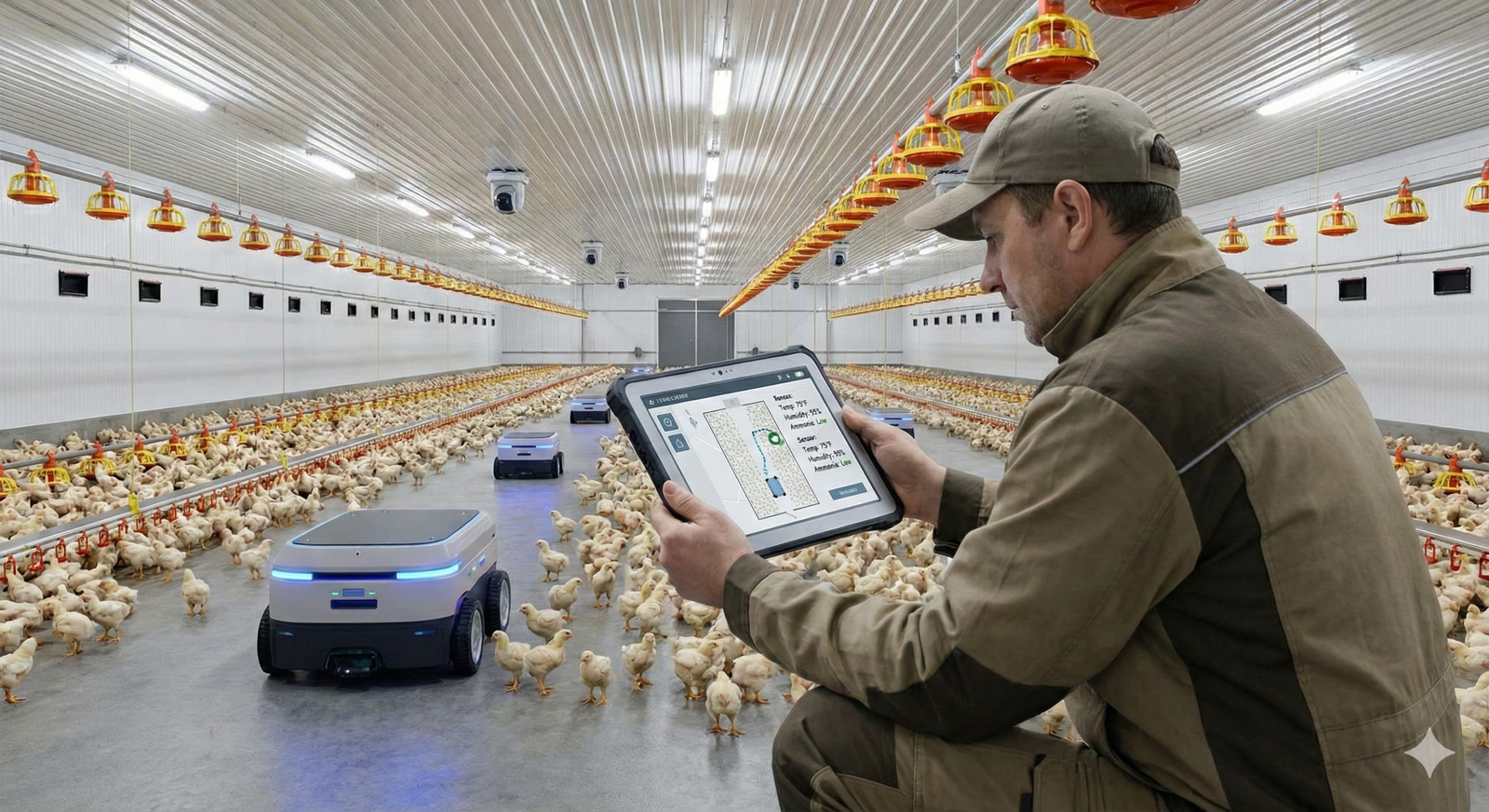
The quintessential image of American farming often involves rolling fields, manual labor, and a simple red barn. Yet, inside the modern US poultry industry, a profound technological shift is rendering this old image obsolete. The broiler sector—dedicated to raising chickens specifically for meat production—is quietly undergoing a high-tech revolution.
Facing unprecedented demand for chicken, the most popular meat in the United States, producers are simultaneously grappling with a crippling rural labor shortage. The solution is no longer just working harder; it’s working smarter. Enter the “Smart Coop,” a data-driven environment where artificial intelligence (AI), multimodal sensors, and autonomous agricultural robotics are transforming everyday operations. This isn’t futuristic speculation; it is the rapid evolution necessary to keep America fed sustainably and efficiently.
The Driving Force: America’s Rural Labor Crisis
To understand why US producers are embracing high-cost technology, one must first understand the demographic crisis facing rural America. The agricultural workforce is shrinking and aging. Attracting younger workers to physically demanding jobs in remote areas has become increasingly difficult for broiler integrators and independent contract farmers alike.
This labor gap creates significant operational risks. A modern broiler house can hold tens of thousands of birds. Relying solely on human laborers to walk the houses, spot sick birds, monitor feed lines, and adjust ventilation is becoming unsustainable.
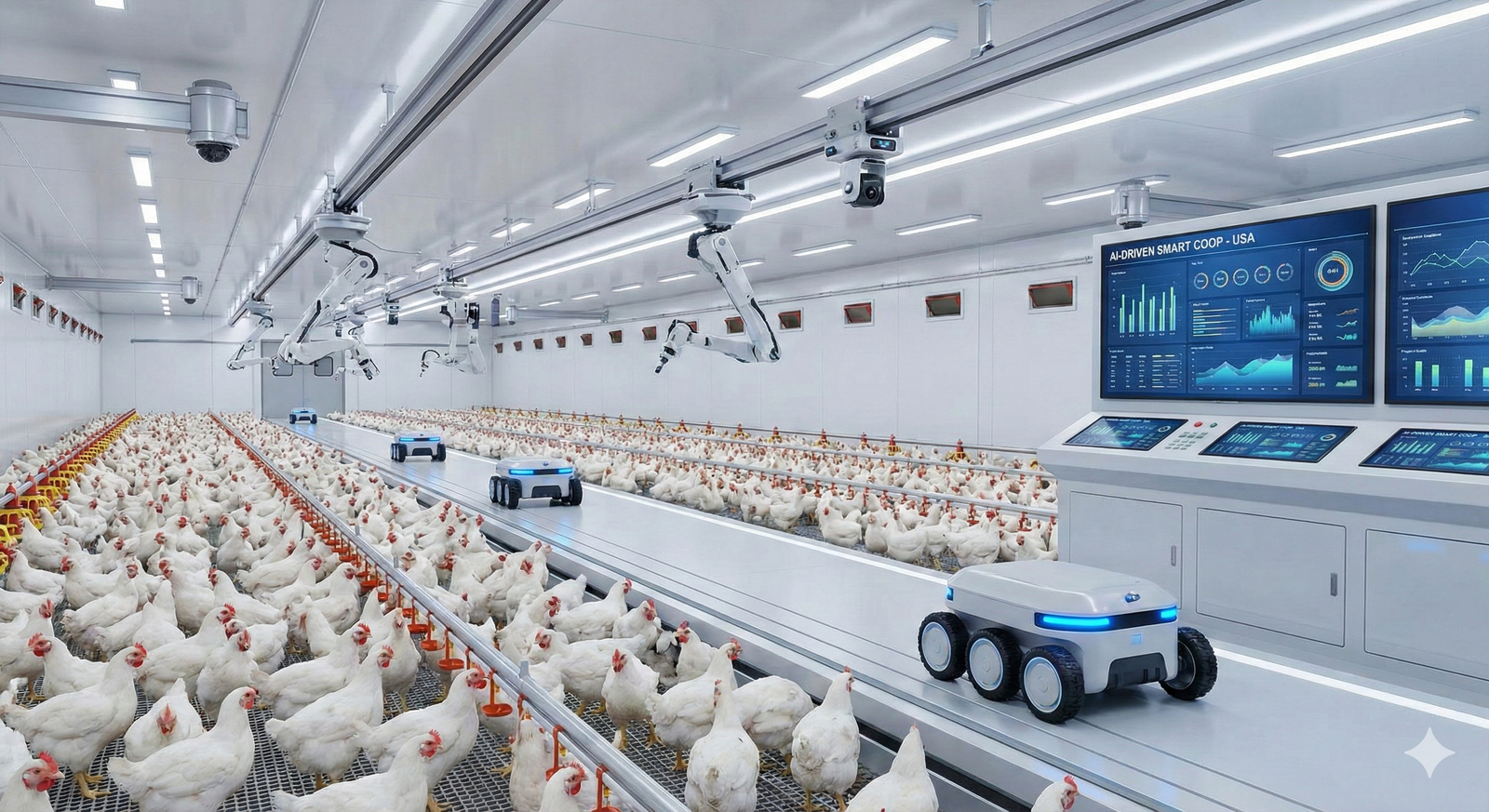
The margin for error in poultry farming is razor-thin; a missed ventilation adjustment or an unnoticed equipment failure can have devastating consequences on flock health and profitability.
The adoption of AI in US broiler farming is not about replacing an abundant workforce with machines. It is about filling a critical vacuum, allowing producers to manage larger operations with fewer hands, shifting the human role from manual labor to strategic management.
Inside the Smart Coop: The Core Technologies
The “Smart Coop” is not defined by a single gadget, but by an ecosystem of integrated technologies that work together to create a near-autonomous growing environment.
Multimodal AI and Computer Vision
The most significant advancement is the move toward multimodal AI in US brosystems. In the past, sensors might only measure temperature or humidity. Today, advanced computer vision systems act as the “all-seeing eye” of the broiler house.
Ceiling-mounted cameras, integrated with AI algorithms trained on millions of images of chickens, constantly scan the flock. So these systems go beyond simple counting. They analyze bird behavior patterns, gait, and feather condition. They can detect early signs of lameness or disease clusters days before a human observer might notice, allowing for targeted intervention rather than mass medication. This level of continuous, non-intrusive autonomous flock monitoring is unprecedented.+1
The Rise of Autonomous Poultry Robots
While cameras watch from above, agricultural robotics in broiler houses are handling the ground game. These autonomous units, often resembling ruggedized roombas, navigate the litter floor 24/7.
Their primary function is often twofold: data collection and bird stimulation. As the robots move, they gently encourage the birds to move around. This exercise is crucial for leg health and ensures birds are actively seeking feed and water, which improves growth rates.
Simultaneously, these robots are loaded with sensors that map the micro-climates within the house. They measure litter moisture levels, ammonia concentrations at bird height, and temperature variations in different zones. This hyper-local data is far more valuable than a single reading from a wall sensor, allowing farmers to address wet spots or drafty corners immediately.
Transforming Operations with Precision Agriculture in Broiler
Furthermore, the data gathered by robots and cameras is useless without intelligent application. So this is where AI-driven analytics systems shine, turning raw numbers into actionable insights for precision agriculture.
Precision Feeding Systems and Waste Reduction
Feed accounts for the single largest cost in broiler production—often up to 70% of total expenses. Precision feeding systems in poultry use AI to optimize this massive cost center.+1
Thus, by constantly monitoring bird weights via automated scales and analyzing consumption patterns, AI systems can adjust feed formulations and delivery in real-time. The goal is to achieve the perfect Feed Conversion Ratio (FCR)—the measure of how efficiently a bird turns feed into body mass. Smart systems ensure that feed lines are working correctly and that birds are not wasting food, potentially saving producers significant amounts of money across dozens of flocks per year.+1
AI-Driven Climate Control in Broiler
Broilers are incredibly sensitive to environmental changes. A functioning ventilation system is life or death. Traditional systems rely on pre-programmed settings based on bird age. Smart poultry coop technology uses predictive AI to manage the climate dynamically.
By analyzing external weather forecasts, internal sensor data, and flock behavior, the AI can preemptively adjust fans, heaters, and evaporative cooling pads. If the AI predicts a heatwave, it can ramp up cooling efforts before the birds become heat-stressed. Crucially, these systems also monitor harmful gases like carbon dioxide and ammonia. Thus ensuring air quality remains optimal for bird respiratory health.
Balancing Efficiency and Animal Welfare
A common criticism of factory farming is that technology distances the farmer from the animal, potentially harming welfare. However, proponents of the Smart Coop argue the opposite is true.
So AI and robotics allow for a move away from flock-average management to individual-bird-centric management. By using autonomous flock monitoring to detect health issues early, suffering can be reduced significantly.
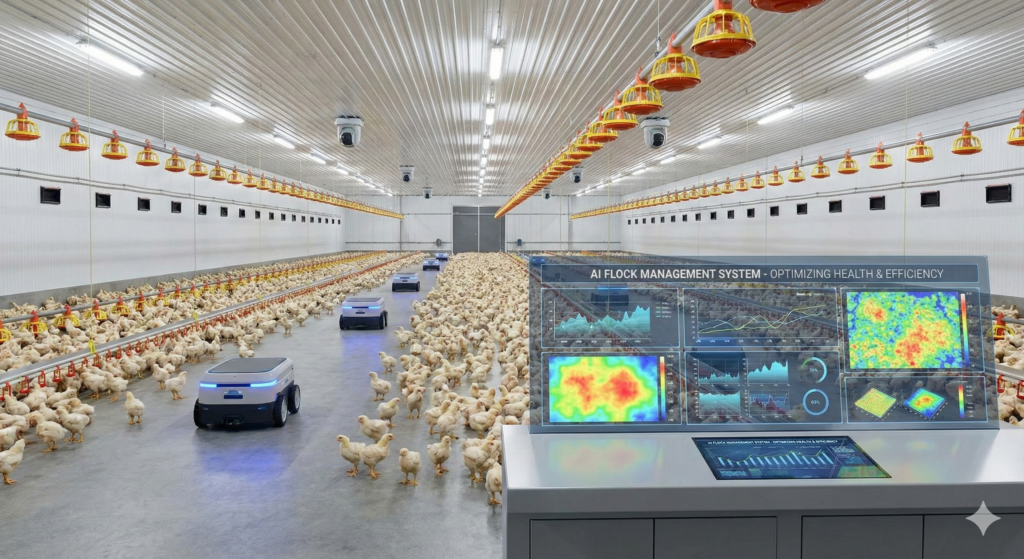
Furthermore, robotic systems reduce the need for frequent human entry into the houses. Humans are perceived as predators by chickens, and our presence causes stress. Robots, which move predictably and slowly, are far less disruptive, leading to calmer birds.
The technology ensures that the birds’ fundamental needs—clean air, appropriate temperature, and access to food and water—are met with mathematical precision, 24 hours a day, regardless of whether a human farmhand has called in sick.
Conclusion: The Future of US Poultry Production and Broiler Farming
The integration of AI and robotics into US broiler farming is still in its relative infancy, but the trajectory is clear. As sensor costs decrease and AI algorithms become more sophisticated, the “Smart Coop” will become the industry standard.
The future will likely see even deeper integration, where farm-level data is seamlessly connected to processing plants and supply chains, creating a fully traceable and optimized food system. For the American farmer, so the adoption of these technologies is the key to survival in a challenging labor market. So, by embracing the digital revolution, US producers are ensuring they can continue to meet the nation’s growing appetite for chicken efficiently, sustainably, and ethically.