As the spring mud begins to dry across the vast steppe of eastern Ukraine. The grim reality of the conflict’s fifth year is setting in. The dynamic maneuvers of 2022 and the hopeful counteroffensives of 2023 and 2024 are distant memories. The Russia-Ukraine war has solidified into a grueling, industrialized war of attrition. A bloody stalemate along a thousand-kilometer Surovikin Line that has barely moved in eighteen months causing Ukraine forced compromise.
While artillery duels continue to claim hundreds of lives daily in the Donbas. The most consequential battles are no longer taking place in trenches near Pokrovsk or Kupiansk. They are happening in closed-door diplomatic meeting rooms in Washington, Brussels, and Berlin.
The rhetorical commitment to supporting Ukraine “as long as it takes” has evaporated, replaced by a cold, hard realpolitik. In March 2026, the international dynamic has fundamentally shifted. The unspoken consensus among Western allies is clear: total military victory for Ukraine—defined as the recapture of all territory up to the 1991 borders—is no longer achievable without an unacceptable level of escalation or economic ruin.
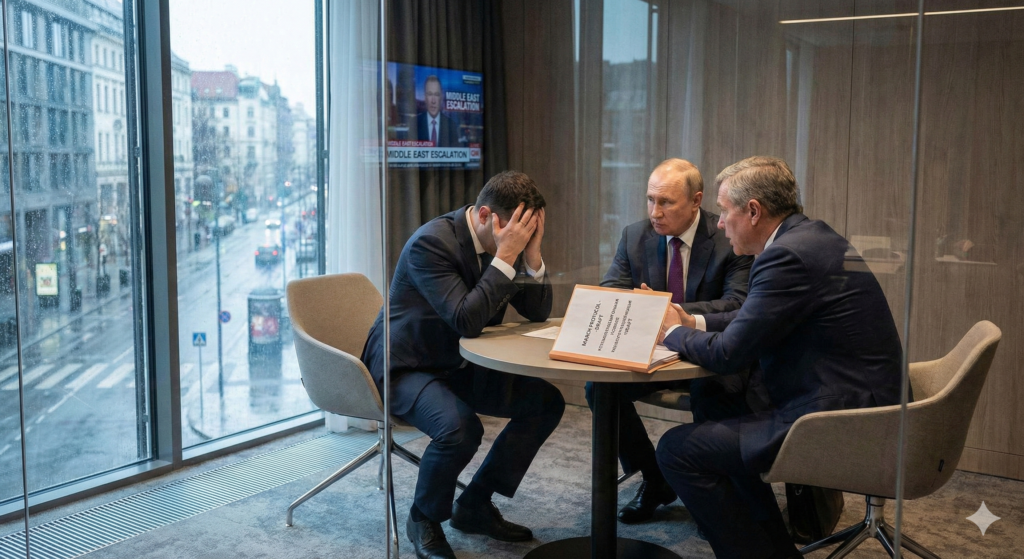
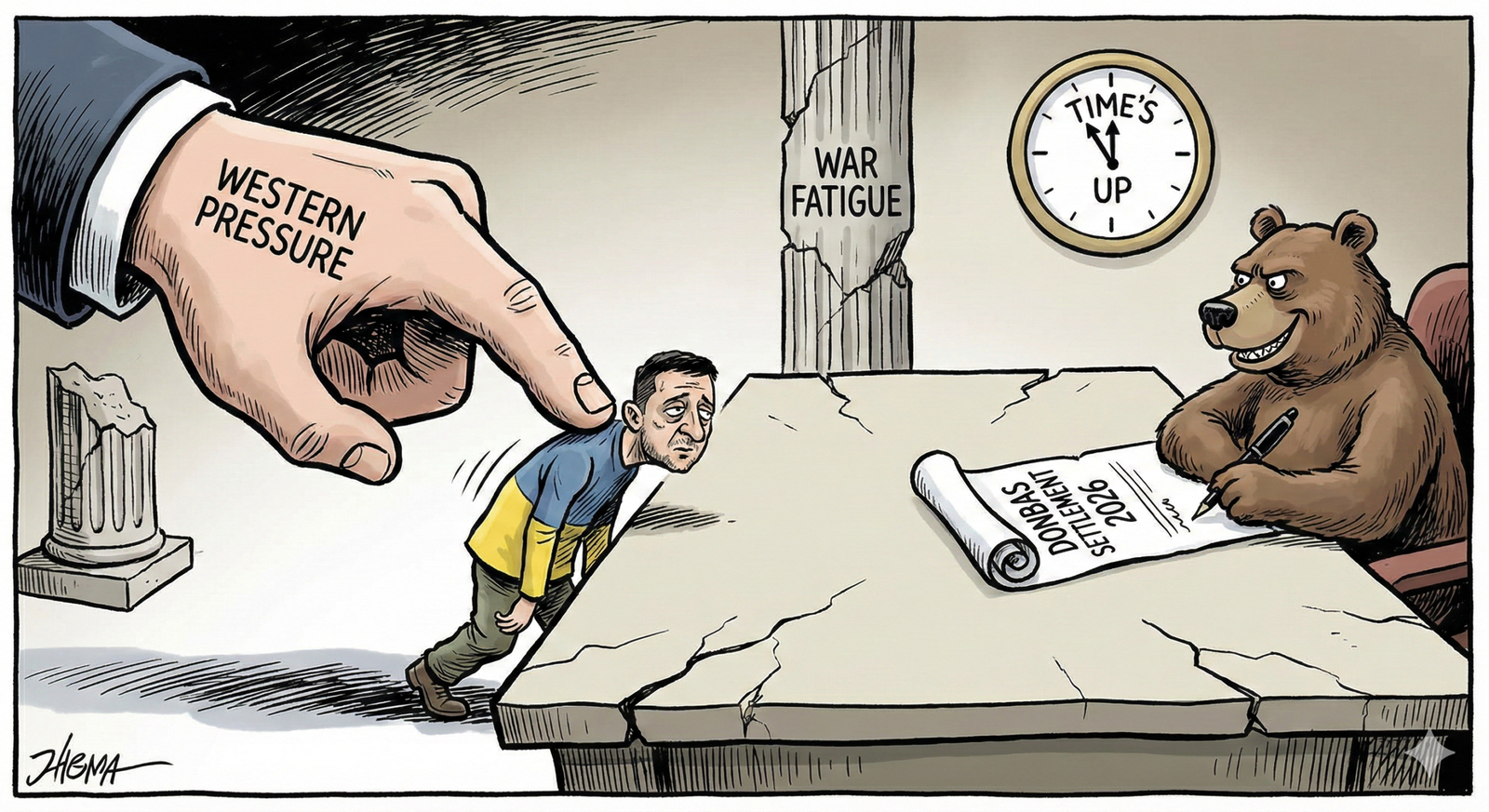
This realization has birthed a new, painful phase of the conflict: the 2026 Donbas settlement push. It is a coordinated diplomatic campaign applying immense pressure on Kyiv to accept the unthinkable—a forced compromise that involves ceding territory to end the fighting.
The Anatomy of War Fatigue: Why the West is Blinking
The shift in international posture was not sudden; it was a slow erosion driven by political changes and material reality. By early 2026, the “coalition of the willing” had become the “coalition of the exhausted.”
Europe is grappling with severe economic headwinds and political fragmentation. Crucial elections in key EU member states over the past two years saw significant gains for populist parties campaigning on “peace now” platforms and an end to funding what they term an “unwinnable forever war.” The patience of European taxpayers, struggling with inflation and energy instability, has worn thin.
Militarily, the cupboard is bare. Despite efforts to ramp up production, NATO stockpiles of 155mm shells and air defense interceptors remain critically low. Western defense ministries are increasingly alarmed at their own vulnerability. Having transferred vast amounts of hardware to Ukraine that has since been destroyed in the attritional meat-grinder of the Donbas. The reality of 2026 is that the West can no longer supply Ukraine at the rate necessary to conduct offensive operations. They can barely supply enough to hold the current line.
This material exhaustion is the primary driver behind the shifting international support for Kyiv. Transforming military aid from a tool for victory into a lever for diplomatic coercion.
The Washington Pivot: A New Administration, A New Calculus
The most decisive factor in this 2026 diplomatic pivot emanates from Washington. The current US administration, having taken power with a mandate to address domestic economic crises. And manage escalating tensions in the Middle East and Asia. Views the Ukraine war through a different lens than its predecessor.
For the White House in 2026, the Ukraine conflict has morphed from a noble defense of democracy into a strategic liability that is bleeding resources and distracting from higher-priority geopolitical threats—specifically, the explosive situation involving Iran and Israel, and the looming challenge of China.
Sources familiar with recent high-level discussions indicate a stark change in tone between US diplomats and their Ukrainian counterparts. The message delivered to Kyiv is practically an ultimatum: the era of blank checks is over. US aid packages passed in late 2025 were significantly smaller, delayed, and carried heavy conditionality rooted in entering peace talks.
Washington’s calculation is cynical but clear. They believe Russia is also nearing exhaustion and that a window exists to freeze the conflict before a potential catastrophic collapse of Ukrainian lines or a desperate escalation by Moscow. The goal of US foreign policy in Ukraine in 2026 is no longer “weakening Russia,” but “stabilizing Europe” and exiting the theater.
The View from Kyiv: Between a Rock and a Hard Place
The pressure cascading down on the government in Kyiv is excruciating. President Zelensky, whose entire political mandate is built on the promise of total liberation. Is being squeezed between the immovable force of Russian occupation and the irresistible pressure of his allies.
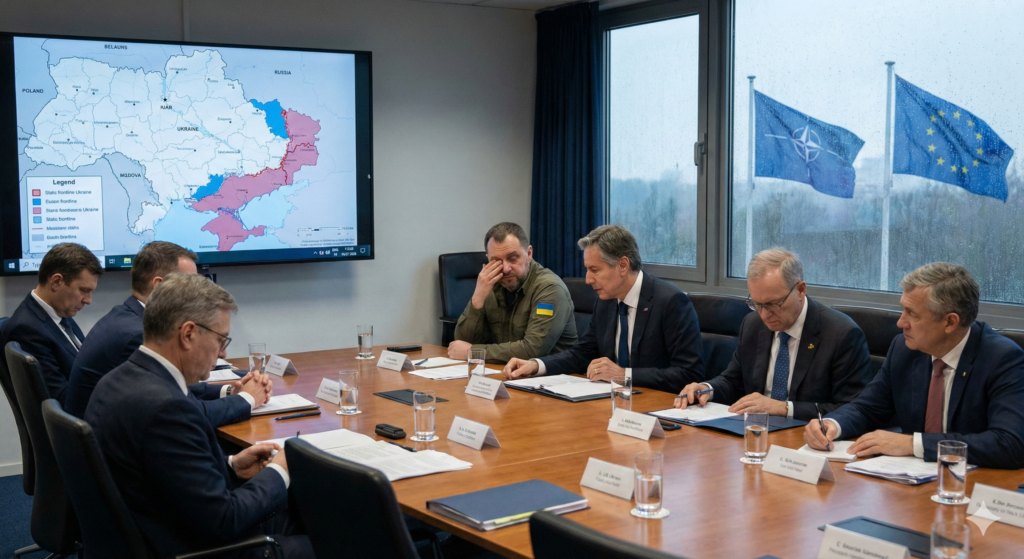
Domestically, accepting a Ukraine forced compromise is political suicide. The Ukrainian population, having sacrificed tens of thousands of their best citizens and endured years of bombardment. Remains largely opposed to trading land for peace. They view any concession as a betrayal of the dead and a guarantee that Russia will re-arm and attack again in five years.
Yet, Kyiv’s generals know the grim reality of the front. Manpower shortages are critical. The average age of a Ukrainian infantryman is now over 40. Without consistent, massive injections of Western artillery and armor, holding the current line through 2027 is doubtful.
So, the Western strategy is to force Kyiv to align its political goals with its military capabilities. Western diplomats are privately warning Zelensky that if he refuses to negotiate now. He may be forced to negotiate later with much less territory under his control and even less leverage.
Visualizing the “Forced Compromise”: The Shape of an Ugly Peace as Ukraine forced compromise.
What does the “2026 push for a Donbas settlement” actually look like in practice? Diplomatic chatter suggests several models are being floated, all of them painful for Ukraine.
The most likely scenario is not a definitive peace treaty, but an armistice leading to a frozen conflict model, similar to the Korean Peninsula but on a massive scale in Europe.
The Potential contours of the 2026 deal:
- Line of Control as De Facto Border: The current frontline, cementing Russian control over roughly 20% of Ukrainian territory (Crimea, most of Luhansk, Donetsk, Zaporizhzhia, and Kherson oblasts), would become a demilitarized zone (DMZ). Neither side would officially recognize the other’s claims, but the fighting would stop.
- Neutrality Instead of NATO: The hardest pill for Kyiv to swallow will be the abandonment of immediate NATO membership. The current US administration and key European allies are unwilling to extend Article 5 guarantees to a nation with disputed borders. Instead, Ukraine would be offered “security assurances”—a heavily armed neutrality modeled somewhere between Israel and pre-2022 Finland, funded by the West but without a direct guarantee of intervention.
- Sanctions Relief for Moscow: To entice the Kremlin to stop at the current lines, the West is prepared to offer phased sanctions relief, particularly in areas that hurt European economies.
Conclusion to Ukraine forced compromise
The push for a settlement in 2026 is a stark admission of the limits of Western power and resolve in a protracted industrial war. It is a pivot away from the idealism of international law—which dictates that borders cannot be changed by force—toward the cold stability of realpolitik.
For Ukraine, a forced compromise will feel like a bitter defeat, a mutilation of their sovereign territory after years of unimaginable sacrifice. For Russia, it will be a pyrrhic victory, gaining ruined territory at an immense strategic and human cost, leaving them isolated and economically scarred.
The looming 2026 settlement will not resolve the underlying conflict; it will merely freeze it in place. It is a solution born not of justice, but of exhaustion. The “ongoing war” may soon transition into an “ongoing frozen conflict,” leaving a deep, militarized scar running across the continent for decades to come.