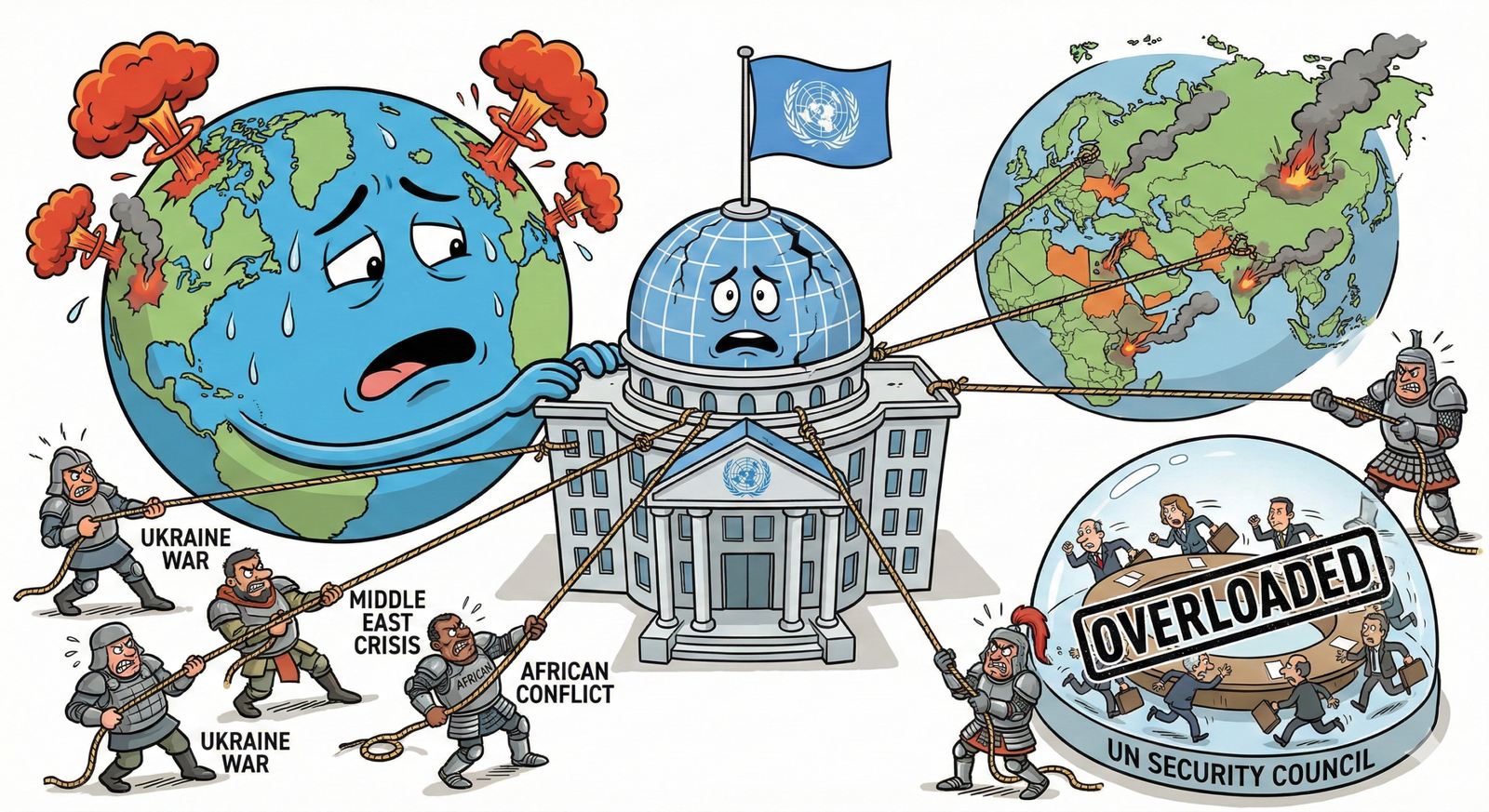
The post-1945 international order was designed with a primary goal. To prevent a third world war by managing conflicts before they spiraled out of control. The cornerstone of this architecture, the UN Security Council (UNSC). It was tasked with the primary responsibility for the maintenance of international peace and security preventing Simultaneous global shocks.
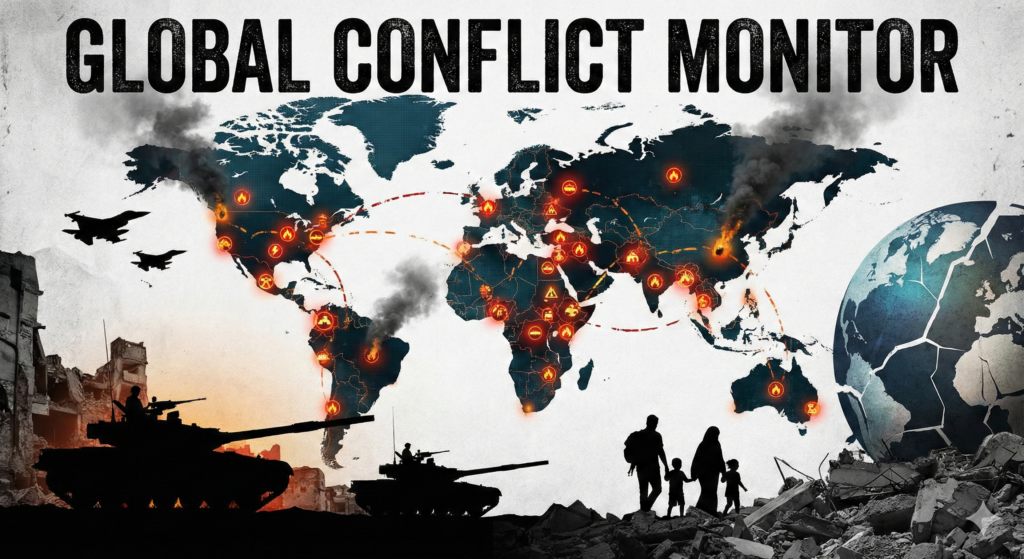
Today, that architecture is buckling under unprecedented pressure. We have entered a new geopolitical epoch—the “era of simultaneous global shocks.” Unlike previous decades where global attention usually focused on one primary theatre of conflict at a time. Today’s landscape is defined by multiple, high-intensity conflicts occurring concurrently across different continents.
From the grinding artillery duels in Eastern Europe to the complex. Multi-front escalations in the Middle East and the devastating civil wars in Africa. The sheer volume of violence is outpacing the world’s capacity to mediate it.
This article provides a geopolitical overview of the immense challenges international bodies face when trying to manage multiple fires at once. Analyzing why the traditional mechanisms of crisis management are failing in the face of this modern “polycrisis.”
Defining the Era of Simultaneous Global Shocks
What defines this current moment is not just the existence of war, but the synchronicity and severity of major conflicts. We are witnessing a convergence of crises where local grievances are rapidly weaponized by global powers, creating a interlocking web of instability.
Currently, international bodies are attempting to juggle several Tier-1 crises simultaneously:
- The War in Ukraine: A high-intensity, conventional land war on European soil involving a nuclear superpower. Which has fundamentally ruptured relations between Russia and the West.
- The Middle East Escalation: The conflict extending from Gaza to Yemen, involving Israel. Hamas, Hezbollah, and Houthi forces, with the looming specter of direct Iranian involvement. Threatens to destabilize global shipping lanes and energy markets.
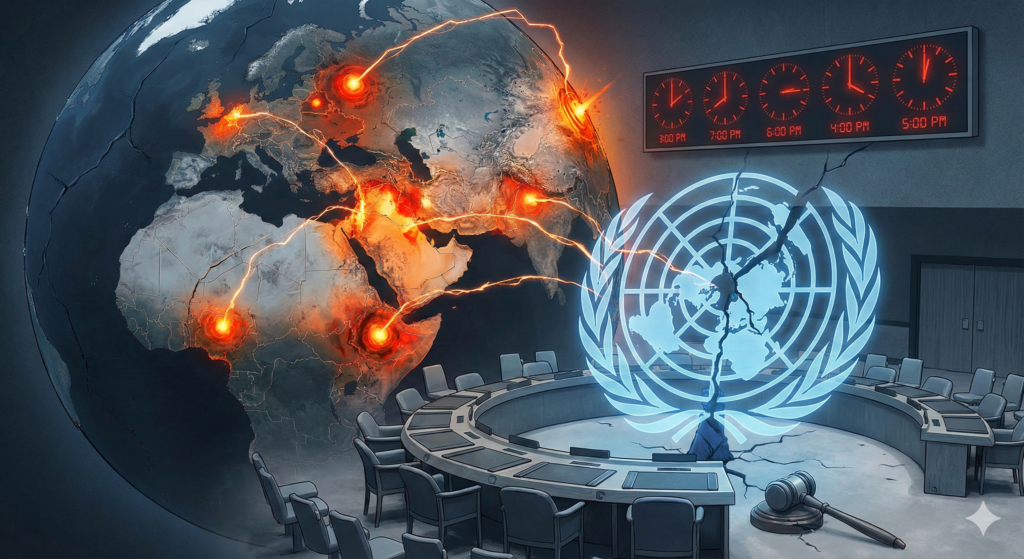
- Sudan’s Catastrophic Civil War: Often termed the “forgotten war,” the conflict between the SAF and RSF has created the world’s largest displacement crisis, destabilizing the critical Horn of Africa region.
- Rising Tensions in the Indo-Pacific: While not open hot wars, increasing militarization around Taiwan and the South China Sea draws immense diplomatic resources and military attention, further stretching global bandwidth.
The defining characteristic of these simultaneous global shocks is that they are not isolated events. They compete for the same limited diplomatic attention, financial resources, and peacekeeping capabilities.
The UN Security Council: A System Paralyzed by Design of Simultaneous global shocks
The central challenge in managing these simultaneous conflicts lies within the structure of the UN Security Council itself. The body was designed for a world of fewer independent states and clearer ideological divides. Today, it is paralyzed by a resurgence of Great Power competition that makes consensus virtually impossible.
The veto power held by the five permanent members (P5)—the US, UK, France, Russia, and China—means that any conflict involving the strategic interests of a P5 member is essentially immune to UN intervention.
- Regarding Ukraine, Russia’s veto power naturally blocks any substantive UNSC resolution condemning the invasion or mandating a ceasefire.
- Regarding Gaza, the United States has repeatedly used its veto to block resolutions calling for immediate humanitarian ceasefires that it deems detrimental to Israeli security or ongoing hostage negotiations.
When the principal guarantors of global security are direct or indirect participants in the world’s major conflicts, the UN’s primary mechanism for conflict resolution is rendered inert. This paralysis forces crisis management outside the UN framework, into ad-hoc coalitions or bilateral negotiations that lack the legitimacy and binding power of international law.
Three Core Challenges of Managing Multiple Fronts
Beyond the structural paralysis of the veto, international bodies face practical, logistical, and psychological hurdles when dealing with simultaneous high-intensity conflicts.
1. The Crisis of Resource Overstretch
The most immediate challenge is a simple lack of bandwidth. International crisis management requires immense resources: diplomatic personnel for negotiations, peacekeepers for stabilization, and billions of dollars for humanitarian aid.
When multiple high-intensity conflicts occur at once, the “market” for these resources crashes. Humanitarian agencies like the World Food Programme (WFP) are forced into impossible choices, cutting rations in Sudan to feed refugees in Gaza, or vice-versa. Donors suffer from “checkbook fatigue.”
Furthermore, there is a finite number of trained, neutral peacekeepers available globally. Deployment to one theatre inevitably means pulling resources from another, leaving fragile regions exposed to renewed violence.
2. “Attention Economy” and Norm Erosion
Geopolitics operates within an attention economy. Global diplomatic bandwidth is finite. When a new massive shock occurs—such as the October 7 attacks and subsequent war in Gaza—diplomatic energy is violently sucked away from existing crises like Ukraine or Sudan.
This inattention is dangerous. Aggressors in “secondary” conflicts know that while the world’s eyes are averted, they can escalate violence with relative impunity.
This leads to a dangerous erosion of international norms. As red lines are crossed repeatedly in multiple theatres—whether regarding the targeting of civilians, the use of prohibited weapons, or the violation of sovereignty—the “shock value” of these violations decreases. The international community becomes desensitized to levels of violence that would have previously triggered immediate intervention.
3. The Geopolitical Linkage Problem
Perhaps the most complex challenge is that these simultaneous global shocks are increasingly interlinked. We are seeing the emergence of loose coalitions of convenience that span across these different conflicts.
For example, Iran’s supply of drones to Russia for use in Ukraine links the European theatre with Middle Eastern dynamics. North Korea supplying artillery to Russia does the same for Asia.
International bodies prefer to treat conflicts in isolation—to have a “Ukraine policy” and a “Sudan policy.” However, in an era of simultaneous shocks, solving one crisis often requires leverage in another. The interconnected nature of modern alliances means that diplomatic pressure applied in one region can have unpredictable blowback in another, complicating the work of mediators who are already stretched thin.
Conclusion: The Urgent Need for Adaptation
The era of simultaneous global shocks has laid bare the uncomfortable truth that the post-WWII international security architecture is no longer fit for purpose in the 21st century. The UN Security Council, paralyzed by the veto and Great Power rivalry, is increasingly becoming a theatre for diplomatic theater rather than a body for effective action.
The current trajectory is unsustainable. If international bodies cannot adapt to manage multiple high-intensity conflicts concurrently, global security will increasingly devolve into a “might makes right” system administered by ad-hoc regional powers.
The challenge for the international community is no longer just about solving individual wars; it is about urgently reforming the mechanisms of global governance before the sheer weight of simultaneous crises causes the entire system to collapse. The world needs a multilateral system that is faster, more representative of the Global South, and less reliant on the unanimity of five powers whose interests are irreconcilably opposed.