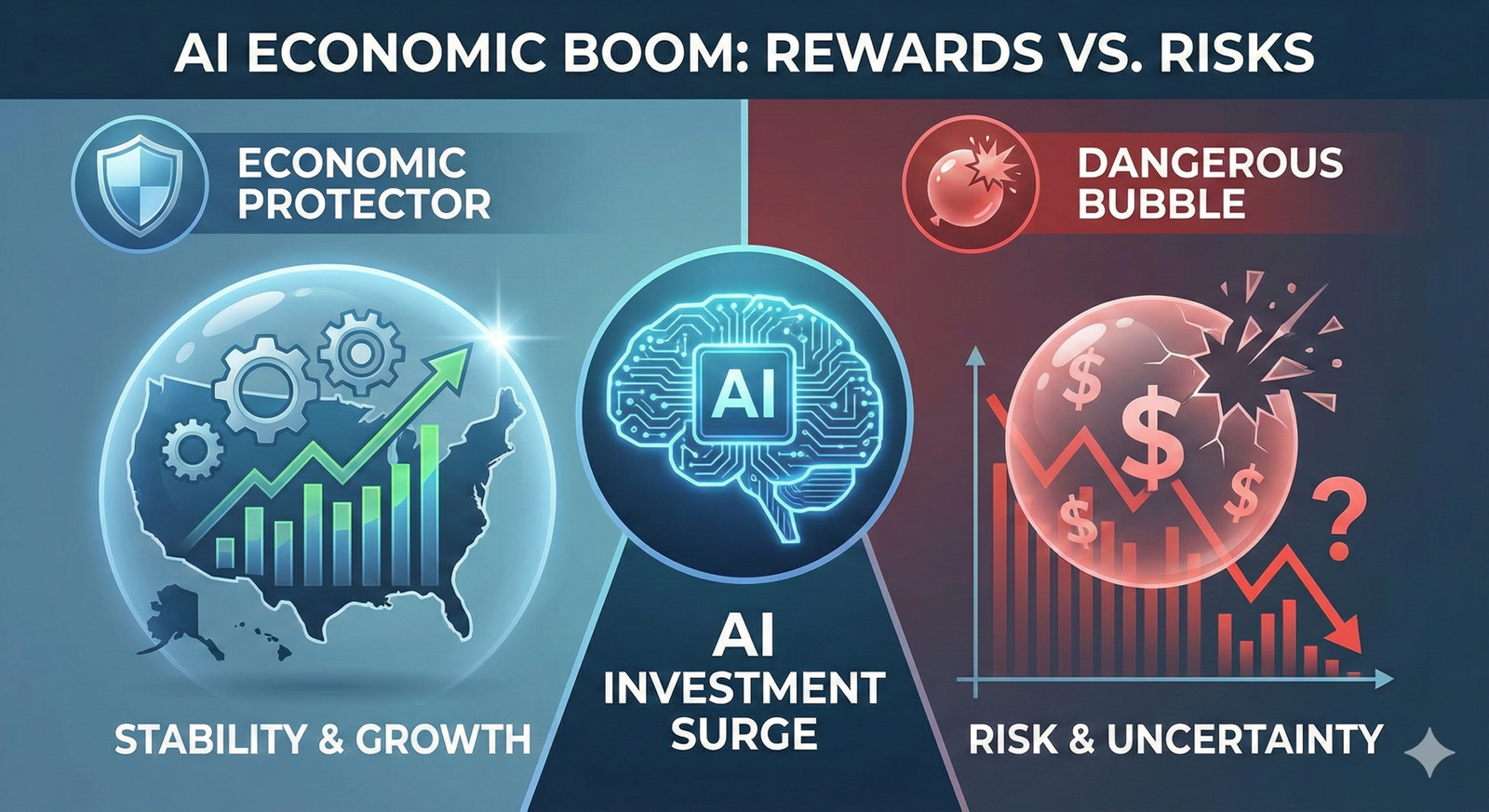
The United States is currently in the grip of an unprecedented financial phenomenon: the artificial intelligence investment boom. It is a gold rush of digital proportions, with hundreds of billions of dollars flowing into generative AI. Data centers, and the specialized semiconductors that power them. In 2026, this surge is no longer just a tech story; it is the dominant narrative of the AI Economic Boom.
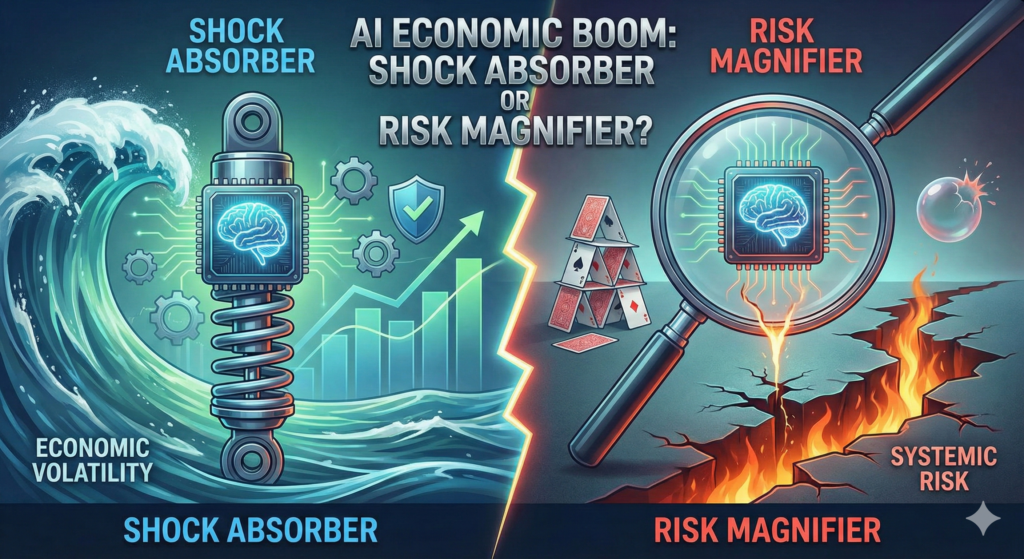
As valuations of tech behemoths soar and AI integrates deeper into everything from healthcare to logistics. A critical debate has emerged among economists and policymakers. Is this massive injection of capital acting as an economic shock absorber. So, propelling productivity and shielding the market from a downturn? Or is it a risk magnifier, creating a hyper-concentrated bubble detached from fundamental realities, poised to destabilize the broader financial system?
The answer is complex, as AI currently plays both roles simultaneously, creating a high-stakes balancing act for the US market.
The Scale of the Surge: A Financial Tsunami AI Economic Boom
To understand the stakes, one must first grasp the sheer magnitude of the investment. By 2025, US private AI investment had already reached an estimated $109.1 billion, dwarfing the combined efforts of other global powers. This figure continues to climb in 2026, driven by an insatiable appetite for generative AI capabilities.
At the center of this maelstrom are the “hyperscalers”—tech giants like Microsoft, Alphabet, and Amazon—along with the undisputed king of AI hardware, Nvidia. Nvidia’s earnings reports have become global financial events, acting as a bellwether for the entire US tech market. The company’s staggering growth reflects a frantic build-out of AI Economic Boom, a capital expenditure (capex) wave not seen since the construction of the internet itself.+1
This torrent of money has undeniably propped up major market indexes. The S&P 500’s performance has become increasingly tethered to a handful of AI-exposed stocks, creating a market that looks robust on the surface but is deeply dependent on the continued success of a single theme.
The Case for the “Shock Absorber”: Productivity’s Promised Land
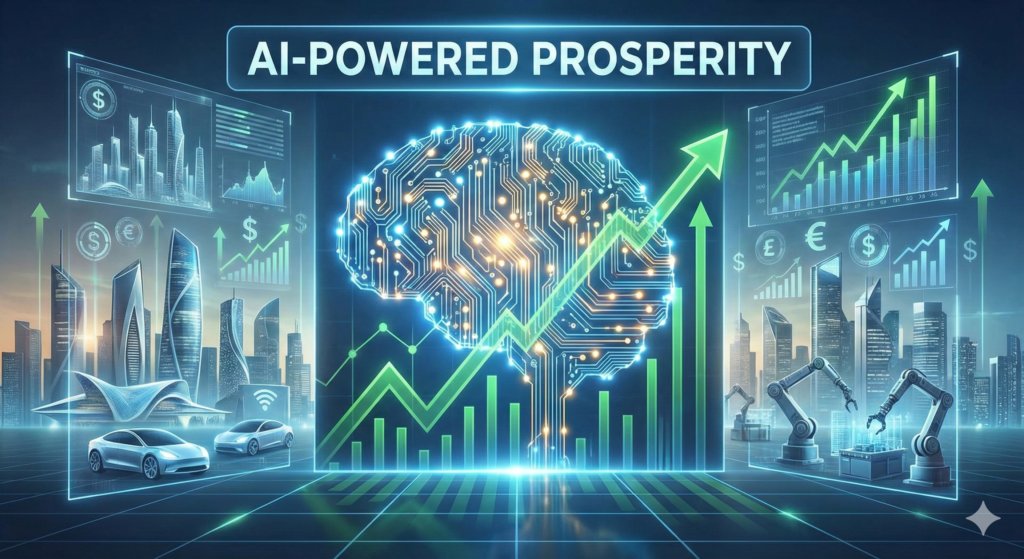
The optimistic view, championed by many venture capitalists and techno-optimists. Posits that this investment is the necessary fuel for a new era of economic prosperity. In this narrative, AI is a “general-purpose technology” akin to electricity or the steam engine. An innovation so fundamental that it will eventually lift productivity across every sector.
Economists modeling the long-term artificial intelligence economic impact project significant gains. Some estimates suggest that AI adoption could boost US GDP by over 1.5% by 2035. With productivity gains accelerating in the early 2030s. So, the argument is that by automating routine tasks, optimizing complex logistics, and accelerating scientific discovery. AI will allow the US economy to achieve more with less. Effectively acting as a buffer against demographic shifts and other structural headwinds.+1
Even in the short term, the sheer volume of spending on data center construction and hardware manufacturing is generating economic activity, creating pockets of intense demand in an otherwise cooling economy. For proponents, these are not signs of a bubble, but the down payments on a more efficient future.
The Case for the “Risk Magnifier”: The Great Disconnect
However, a growing chorus of skeptical economists and market analysts points to flashing warning signs. Their primary concern is the “risk multiplier” effect of a market that has become dangerously concentrated and detached from immediate reality.
The core of this argument is the massive disconnect between infrastructure spending and current revenue. Also, reports indicate a gap of hundreds of billions of dollars between the massive capex being poured into AI infrastructure and the actual revenue currently generated by AI services. Companies are building massive capacity for a demand curve that has not yet fully materialized. This “build it and they will come” mentality bears eerie similarities to the dot-com bubble of the late 1990s, where vast sums were spent on fiber-optic networks that took years to become profitable.+2
Furthermore, the benefits of the boom are unevenly distributed. The incredible rise in stock market value is heavily concentrated in a few mega-cap tech companies. This tech market concentration means that a stumble by a single key player—like a disappointing earnings quarter from Nvidia or regulatory headwinds for OpenAI—could trigger a disproportionate shockwave throughout the entire financial system. The market has effectively put all its eggs in the AI basket causing AI Economic Boom. +2
A National Bureau of Economic Research study highlighted a “productivity paradox,” noting that despite high executive expectations, a vast majority of firms report no current impact on productivity. The hype, it seems, is currently outpacing the practical implementation.+1
The Human Toll: Labor Market Disruptions in 2026
So, the dual nature of the AI boom is perhaps most visible in the US jobs market. In 2026, the labor landscape is defined by a stark divergence. On one side, there is a frantic scramble for AI talent. Job postings explicitly mentioning “artificial intelligence” or “generative AI” skills are seeing explosive growth, even as broader hiring remains muted.
On the other side, the disruptive effects are beginning to be felt. Economists have noted early signs of displacement, particularly among young professionals in fields previously considered safe, such as software development and certain creative industries. While history suggests that technological revolutions eventually create more jobs than they destroy, the transition period is painful.
Currently, AI is acting as a risk magnifier for labor stability, creating a “winners and losers” dynamic where capital owners and highly specialized AI workers reap the rewards. While a significant portion of the workforce faces uncertainty and wage pressure.
Conclusion: Navigating the Knife’s Edge of AI Economic Boom
So, is the massive surge in artificial intelligence investment an economic shock absorber or a risk magnifier? In 2026, the verdict is that it is both.
It is a shock absorber in that the sheer volume of capital investment is propelling economic activity and supporting market valuations. Driven by a genuine belief in a transformative future. The long-term potential for productivity gains is real and could eventually lead to a more robust economy.
Yet, it is undeniably a risk magnifier. The historic concentration of market gains, the massive gap between capex and revenue. And the disruptive impact on the labor market have created a financial system with heightened vulnerability. The US market is walking a knife’s edge, balancing unprecedented hype with the slow, hard work of real-world integration.
The ultimate outcome will depend on the speed at which the promise of AI Economic Boom into tangible, widespread economic value. Until then, investors, policymakers, and workers alike must navigate a landscape. Where the next great economic leap forward is inextricably linked to the next great financial risk.