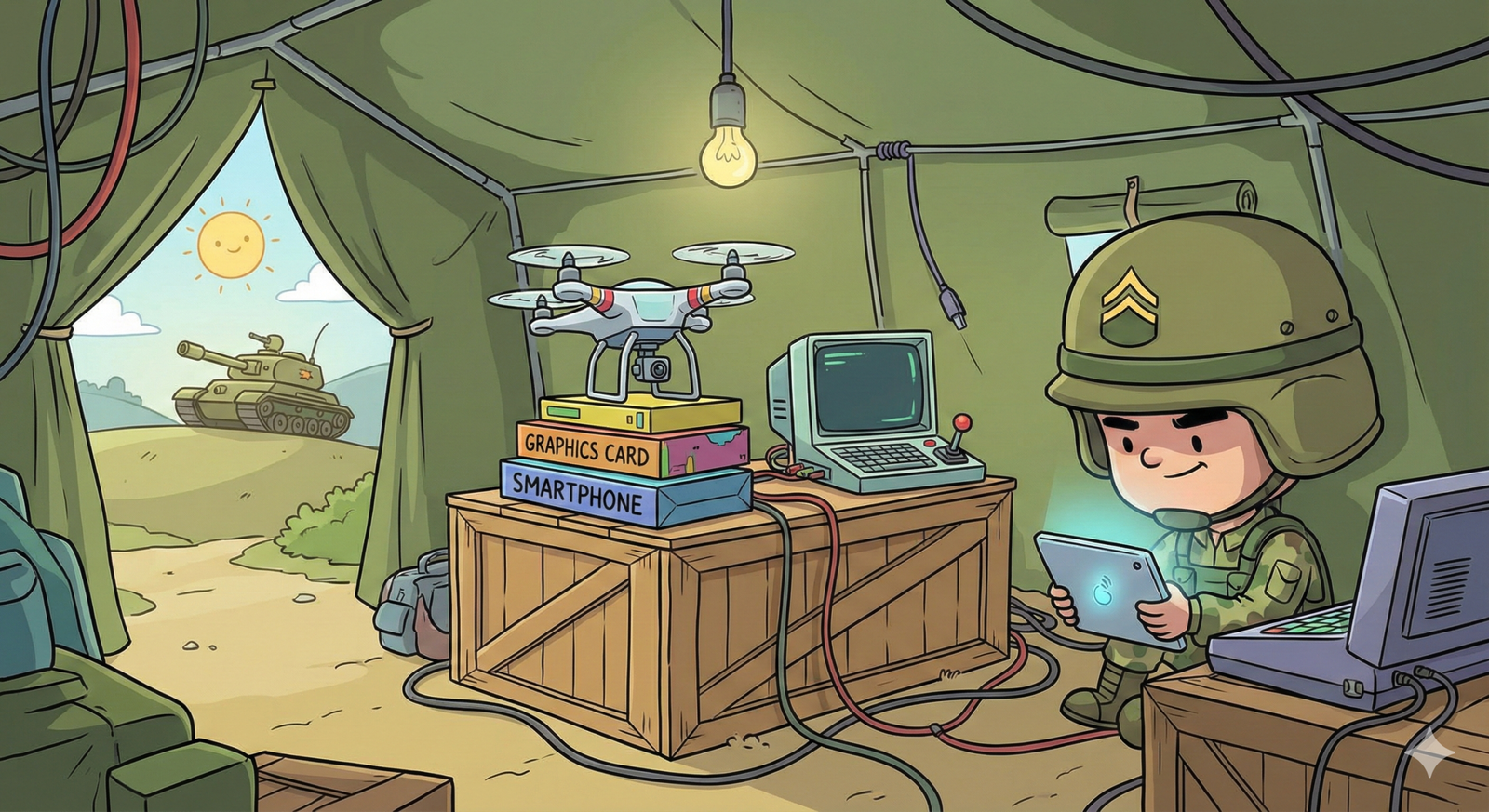
The traditional image of warfare involves billion-dollar defense contracts, bespoke weapons systems developed over decades, and technology accessible only to superpowers. While aircraft carriers and stealth fighters still hold strategic importance, the tactical reality of modern conflict has shifted dramatically. The frontline is no longer just defined by heavy artillery; it is being redefined by Consumer tech in warfare.
So, we have entered the era of the “Silicon Battlefield.” In conflicts spanning from the Middle East to Eastern Europe, the defining characteristic is the rapid, improvised adaptation of consumer tech in warfare. Commercial Off-The-Shelf (COTS) technology—items designed for hobbyists, gamers, and everyday communicators—are being weaponized with devastating effectiveness, blurring the lines between civilian innovation and military hardware.
This article examines how everyday technology, from high-performance computing parts to hobbyist drones, is reshaping military strategy, democratizing airpower, and altering the intelligence landscape.
The Rise of “Dual-Use” Technology
So, historically, military technology filtered down to the consumer market (e.g., GPS, the internet, duct tape). Today, the flow has reversed. The pace of innovation in the consumer sector, driven by fierce competition among tech giants like Apple, Nvidia, and DJI. Vastly outpaces the slow, bureaucratic procurement processes of traditional defense departments.
So, this has led to an overreliance on “dual-use” technology. Products designed for peaceful civilian purposes that can be easily adapted for combat. The modern soldier’s toolkit is just as likely to contain an iPad and a commercial drone controller as it is a standard-issue rifle. This shift means that military advantage is no longer just about who has the biggest budget. But who can innovate the fastest using widely available tools.
The Democratization of Airpower: Commercial Drones and Consumer tech in warfare
But, perhaps the most visible symbol of this shift is the commercial quadcopter. For decades, airpower was the exclusive domain of nations that could afford multi-million dollar jets and large Predator drones. Today, a $500 drone bought online has democratized air support.
The FPV Revolution
In recent high-intensity conflicts, commercial drones, particularly those made by companies like DJI, have become ubiquitous. Initially used for simple reconnaissance, their role has rapidly evolved.+1
The most significant development is the weaponization of First-Person View (FPV) drones. These agile, high-speed drones, originally designed for competitive racing, are being strapped with improvised explosives—from grenades to RPG warheads. Piloted by soldiers wearing VR goggles, these cheap devices can maneuver into trenches, bunkers, or even the open hatches of armored vehicles.
The economic asymmetry is staggering. A $400 consumer FPV drone can effectively disable or destroy a main battle tank worth millions of dollars. This reality is forcing military strategists worldwide to completely rethink armored warfare doctrine.
The “Eye in the Sky” for Every Squad
Beyond direct attacks, consumer drones provide unprecedented situational awareness. Platoon commanders no longer need to rely on corps-level assets for reconnaissance. They can launch a Mavic drone and get a real-time 4K video feed of the terrain ahead, spotting enemy troop movements and correcting artillery fire with terrifying precision. This hyper-local intelligence gathering changes the tempo of infantry engagements.
The Gaming Rig as a Weapon System: PC Components at War
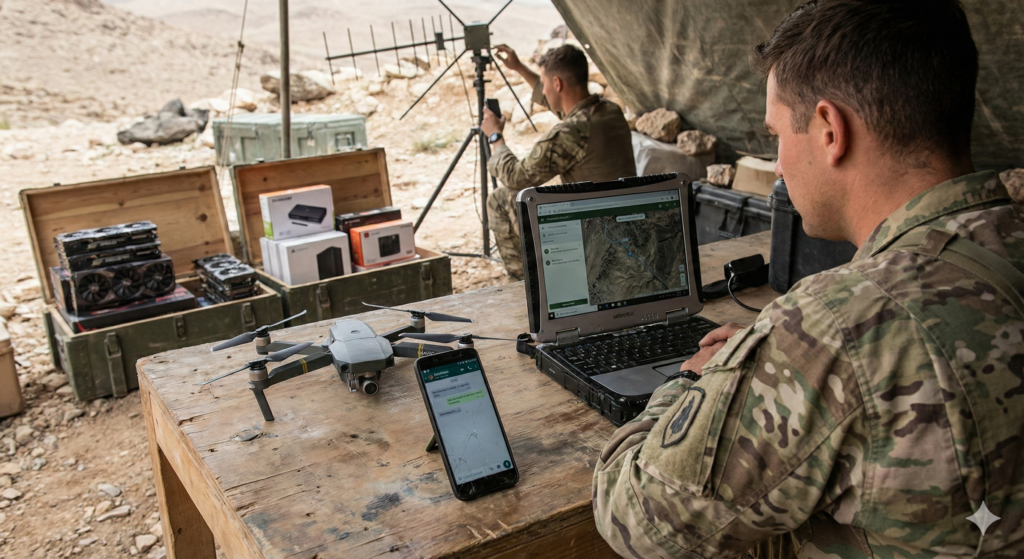
While drones own the skies, Consumer tech in warfare, the processing power driving modern warfare is happening on the ground, often utilizing hardware originally designed for high-end gaming PCs.
Modern warfare generates immense amounts of data—hours of drone footage, intercepted communications, and satellite imagery. Analyzing this data in real-time requires massive computational power. This is where high-performance consumer PC components enter the fray.
GPUs and AI at the Edge
Graphics Processing Units (GPUs), spearheaded by companies like Nvidia and AMD, are the backbone of PC gaming. However, their ability to handle parallel processing tasks makes them ideal for running artificial intelligence and machine-learning algorithms.
In the field, laptops and ruggedized desktops outfitted with top-tier consumer GPUs are used to process live video feeds from drones. AI software running on these consumer cards can automatically identify targets—distinguishing between a civilian vehicle and a military truck—faster than a human operator. This “edge computing” capability brings advanced intelligence analysis right to the frontline command post, without needing a connection to a distant data center.
Furthermore, high-speed consumer CPUs and vast amounts of RAM are essential for running complex simulation software used for training, as well as for cryptographic applications used to secure—or crack—communications.
The Smartphone Soldier and Connectivity of Consumer tech in warfare
The modern battlefield is networked, and the primary interface for that network is often a standard smartphone.
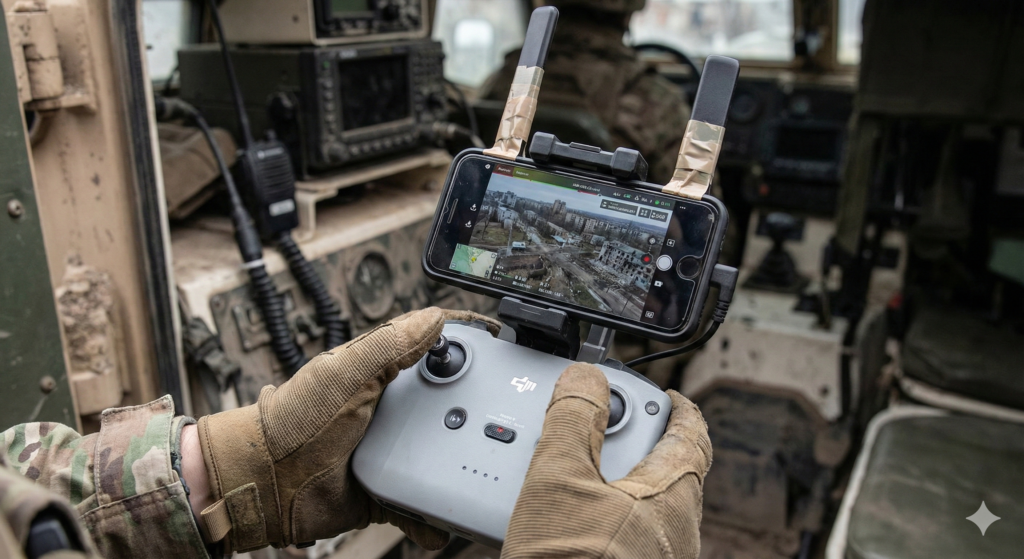
Soldiers are utilizing commercial apps for a variety of tactical tasks. Ballistics calculators help snipers adjust their aim. Offline mapping applications provide navigation when GPS is jammed. Most critically, encrypted messaging apps like Signal and Telegram have become the default communication backbone for many units, replacing clunky, unsecured military radios for squad-level coordination.+2
The Starlink Factor
Connectivity itself has become a consumer commodity weaponized for war. Satellite internet services like Starlink, designed to provide broadband to rural homes, have become critical military infrastructure. They provide high-speed, relatively resilient internet access in warzones where cell towers and fiber optics have been destroyed, allowing units to stream drone footage and coordinate operations in real-time.+1
Open-Source Intelligence (OSINT): The Citizen Spy
The silicon battlefield extends far beyond the physical combat zone. Consumer technology has given rise to a powerful new form of warfare: Open-Source Intelligence (OSINT).
In the past, intelligence gathering was the realm of spies and U-2 spy planes. Today, a global army of internet sleuths uses commercially available satellite imagery (like Google Maps or Maxar), social media posts (TikTok videos of troop movements), and flight tracking apps to piece together a near-real-time picture of a conflict.
Geolocating a soldier’s Instagram post can reveal the location of a hidden base. Analyzing the background of a news report can expose equipment shortages. This “citizen intelligence” complex often moves faster than official government agencies, shaping public perception and providing actionable data to combatants.
Conclusion: The Consumer tech in warfare
The integration of consumer tech in warfare is not a temporary trend; it is the new paradigm. The speed at which commercial technology evolves means that military-specific hardware will almost always be generations behind what is available on Amazon.
This shift presents significant challenges. It creates new vulnerabilities in military supply chains, as dependence on foreign-made chips and components becomes a national security risk. It also raises ethical questions about the dual-use nature of technology, where software developers and hardware engineers find their creations repurposed for lethal means.
As we look to the future, the armies that succeed will not necessarily be those with the largest industrial bases, but those with the most adaptable cultures—the ones capable of integrating the latest silicon valley breakthrough onto the muddy battlefield faster than their adversary. The silicon battlefield is here, and it is powered by the device in your pocket.